This is a technical dissection of SGLang — a system for efficient execution of structured language model programs. SGLang has two halves that are easy to confuse: a frontend language for expressing multi-call LLM workflows, and a backend runtime for executing them fast. The centre of gravity for this article is the runtime — specifically RadixAttention, the mechanism that turns “requests often share a prefix” into “then stop recomputing that prefix.”
I am not reproducing the paper. The throughput and latency numbers matter here only as evidence that the runtime’s design choices — reuse KV cache, schedule around it, decode constrained tokens in bulk — actually pay off.
Attribution convention. Because this article mixes what the paper says with my own reasoning, every non-obvious technical claim is tagged:
- [Paper] — stated explicitly in SGLang (NeurIPS 2024).
- [Derived] — a mathematical or logical consequence of the paper’s definitions, worked out here.
- [Interpretation] — my explanation or engineering reasoning, written for the reader; not a claim the paper makes.
Reasoning / Why I Studied This Paper
I have been studying LLM inference systems — how large models are actually served under real workloads — and SGLang kept coming up from two very different directions at once. [Interpretation]
The first time I met the name, it felt a lot like DSPy: both let you write an LLM application as a program instead of hand-concatenating strings, treating the interaction with the model as a computation graph rather than a single API call. [Interpretation] But that similarity is only skin-deep, and pinning down the difference is what made the paper click for me:
- DSPy is closer to an LLM programming + optimization/compiler framework. It asks “what pipeline should I build, and how do I optimize the prompts?” and largely stops at that level.
- SGLang is closer to an LLM programming language + high-performance runtime. It asks “how do I express this workflow, and how do I execute it efficiently on an inference engine?” — and it goes all the way down into KV cache management, scheduling, batching, and constrained decoding. [Interpretation]
The paper itself draws this line explicitly: high-level systems like LangChain and DSPy can be compiled down to low-level systems like SGLang, and the authors actually use SGLang as a backend for DSPy in their evaluation. [Paper] So the two are not rivals stacked side by side; they sit at different heights in the stack:
flowchart TB
    APP["🧠 Application / Agent Logic<br/>multi-step planning · tool use · reasoning"]

    subgraph HIGH["High-level: what pipeline & how to optimize prompts"]
        DSPY["DSPy / LangChain<br/>signatures · modules · prompt optimizers"]
    end

    subgraph FRONT["SGLang Frontend — how to express the workflow"]
        LANG["Python-embedded DSL<br/>gen · select · extend · fork · join · image/video"]
    end

    subgraph RT["SGLang Runtime (SRT) — how to execute it efficiently"]
        R1["RadixAttention<br/>KV cache reuse"]
        R2["Compressed FSM<br/>constrained decoding"]
        R3["Cache-aware scheduler<br/>+ continuous batching"]
    end

    subgraph LOW["Systems layer"]
        SYS["KV cache · paged memory · attention kernels<br/>tensor parallelism · CUDA / Triton / FlashInfer"]
    end

    GPU["🖥️ GPU"]

    APP --> DSPY
    DSPY -->|"compiles down to"| LANG
    APP -.->|"can target directly"| LANG
    LANG --> RT
    RT --> LOW --> GPU

    classDef appCls fill:#f1f5f9,stroke:#475569,color:#0f172a;
    classDef highCls fill:#ede9fe,stroke:#7c3aed,color:#4c1d95;
    classDef frontCls fill:#dbeafe,stroke:#2563eb,color:#1e3a8a;
    classDef rtCls fill:#dcfce7,stroke:#16a34a,color:#14532d;
    classDef lowCls fill:#fef9c3,stroke:#ca8a04,color:#713f12;
    classDef gpuCls fill:#ffedd5,stroke:#ea580c,color:#7c2d12;

    class APP appCls;
    class DSPY highCls;
    class LANG frontCls;
    class R1,R2,R3 rtCls;
    class SYS lowCls;
    class GPU gpuCls;
    style HIGH fill:#faf5ff,stroke:#7c3aed,stroke-width:2px;
    style FRONT fill:#eff6ff,stroke:#2563eb,stroke-width:2px;
    style RT fill:#f0fdf4,stroke:#16a34a,stroke-width:2px;
    style LOW fill:#fefce8,stroke:#ca8a04,stroke-width:2px;
My mental stack for placing SGLang. The frontend feels DSPy-like, but the value the paper is really chasing lives in the runtime layer — and that is where this article spends most of its time. [Interpretation]
Because I had already worked through the KV-cache lifecycle in vLLM’s PagedAttention and MOONCAKE, SGLang slotted into the same story from a new angle: vLLM manages KV memory efficiently, MOONCAKE moves KV across a cluster, and SGLang is about not creating redundant KV in the first place. [Interpretation]
I. The Problem: LLM Programs Are Not Request → LLM → Response
The paper’s starting observation is that modern LLM usage has moved past single chat turns into “Language Model Programs” (LM programs) — programs that schedule and control the generation process of one or more LLMs. [Paper] These programs have two defining properties: [Paper]
- They contain multiple LLM calls interspersed with control flow — to complete complex tasks and improve quality.
- They receive structured inputs and produce structured outputs — so LM programs can be composed and integrated into existing software.
Concretely, that means a real application is rarely one prompt. It is some mix of: [Paper] [Interpretation]
- multiple, often dependent, generation calls (agents, multi-turn planning),
- branching and parallel exploration (tree-of-thought, skeleton-of-thought),
- repeated prompts and shared prefixes (few-shot examples, a fixed system prompt, RAG context),
- constrained generation (JSON that must match a schema),
- programmatic control flow around all of it.
The paper identifies two inefficiencies that current systems suffer when they run these programs: [Paper]
- Programming them is tedious. The non-deterministic nature of LLMs forces extensive string manipulation, brittle output parsing, and manual parallelism — even simple programs become hard to read. [Paper]
- Executing them is wasteful. State-of-the-art engines (vLLM, TGI, TensorRT-LLM) are optimized without knowledge of the workload. They are general and robust but leave workload-specific opportunities on the table. [Paper] The prominent example: during batched execution of LM programs, many calls share a common prefix, yet the KV cache is discarded after each request finishes, so the shared prefix is recomputed again and again. [Paper] A second example: constrained decoding masks disallowed tokens one token at a time, even when many tokens are forced and could be emitted at once. [Paper]
The question SGLang answers: what is inefficient about running these LM programs the normal way, and what does a co-designed language + runtime change? [Interpretation]
II. The SGLang Programming Model (The Frontend)
SGLang is a domain-specific language embedded in Python. Because it is embedded, you keep Python’s control flow and libraries and simply drop in primitives for generation and parallelism. [Paper] The primitives are: [Paper]
| Primitive | What it does |
|---|---|
gen("name", regex=…, stop=…) |
Call the model, store the result in a named variable; the optional regex constrains the output to a grammar (e.g. a JSON schema). |
select("name", choices=[…]) |
Let the model choose the highest-probability option from a list. |
+= / extend |
Append a string (or primitive) to the prompt state. |
s["name"] |
Fetch the result of a generation. |
fork(k) |
Create k parallel copies of the prompt state. |
join |
Rejoin forked prompt states. |
image, video |
Take multi-modal inputs. |
A running example. The paper’s showcase is a multi-dimensional essay judge built with the branch-solve-merge technique. Reading it top to bottom is the fastest way to feel the model: [Paper]
@function
def multi_dimensional_judge(s, path, essay):
    s += system("Evaluate an essay about an image.")
    s += user(image(path) + "Essay:" + essay)
    s += assistant("Sure!")

    # Return early if the essay is not related to the image
    s += user("Is the essay related to the image?")
    s += assistant(select("related", choices=["yes", "no"]))
    if s["related"] == "no":
        return

    # Judge multiple dimensions IN PARALLEL (branch)
    forks = s.fork(len(dimensions))          # dimensions = ["Clarity","Originality","Evidence"]
    for f, dim in zip(forks, dimensions):
        f += user("Evaluate based on the following dimension:" + dim + ". End your judgment with 'END'")
        f += assistant("Judgment:" + gen("judgment", stop="END"))

    # Merge the judgments (merge)
    judgment = "\n".join(f["judgment"] for f in forks)

    # Summarize into a schema-constrained JSON (solve)
    s += user("Provide the judgment, summary, and a letter grade")
    s += assistant("In summary," + gen("summary", stop=".") + "The grade is" + gen("grade"))
    schema = r'\{"summary": "[\w\d\s]+\.", "grade": "[ABCD][+-]?"\}'
    s += user("Return in the JSON format.")
    s += assistant(gen("output", regex=schema))
Notice what each primitive quietly buys you, because these are exactly the hooks the runtime later exploits: [Interpretation]
selectandifmix model decisions with Python control flow.forkmakes the three dimension-judgments run in parallel — and they all share the same long prefix (system + image + essay), which is a KV-cache reuse opportunity. [Paper]gen(..., regex=schema)is a constrained decode that the compressed FSM will accelerate. [Paper]
The paper reports that an equivalent program written against an OpenAI-style completion API would take about 2.1× as many lines, because of all the manual string manipulation and parallelism plumbing. [Paper]
Execution modes. The default is an interpreter: the prompt is treated as an asynchronous stream, and primitives like extend, gen, and select are submitted to that stream without blocking — Python keeps running while generation happens in the background, “similar to launching CUDA kernels asynchronously.” [Paper] Each prompt is managed by a stream executor in a background thread, which is what enables intra-program parallelism (the forks actually overlap). Fetching a result blocks until it is ready, preserving correctness. Programs can alternatively be traced and compiled into computational graphs for more optimization (Appendix D). [Paper]
Where SGLang sits among LLM languages. The paper’s Table 1 compares it with LMQL and Guidance: [Paper]
| System | Syntax | Language primitives | Runtime backends |
|---|---|---|---|
| LMQL | Custom | extend, gen, select |
HF Transformers, llama.cpp, OpenAI |
| Guidance | Python | extend, gen, select, image |
HF Transformers, llama.cpp, OpenAI |
| SGLang | Python | extend, gen, select, image, video, fork, join |
SGLang Runtime (SRT), OpenAI, Anthropic |
The distinguishing move is not the surface syntax — it is that SGLang ships its own co-designed runtime (SRT) and adds fork/join so that intra-program parallelism becomes something the runtime can see and optimize. [Paper] [Interpretation]
III. Runtime Architecture Overview
The paper’s system diagram is deliberately simple: an interpreter executes language primitives against an optimized runtime. [Paper]
The frontend and backend can work together or independently — you can point the frontend at OpenAI, or drive SRT from another framework. [Paper] The runtime’s leverage comes from three optimizations, each targeting one of the inefficiencies from Section I: [Paper]
flowchart LR
    subgraph CLIENT["🟦 SGLang Client (Frontend)"]
        PRIM["Language primitives<br/>gen · select · fork · join · image/video"]
    end

    INT["⚙️ Interpreter<br/>async prompt stream<br/>intra-program parallelism<br/>frontend hints"]

    subgraph BACKEND["🟩 SGLang Runtime (SRT — Backend)"]
        direction TB
        O1["① RadixAttention<br/>automatic KV cache reuse<br/>(Sec 3)"]
        O2["② Compressed FSM<br/>fast constrained decoding<br/>(Sec 4)"]
        O3["③ API Speculative Execution<br/>for API-only models<br/>(Sec 5)"]
    end

    GPU["🖥️ GPU execution<br/>paged KV · attention kernels · tensor parallelism"]

    PRIM --> INT --> BACKEND --> GPU

    classDef clientCls fill:#dbeafe,stroke:#2563eb,color:#1e3a8a;
    classDef intCls fill:#ede9fe,stroke:#7c3aed,color:#4c1d95;
    classDef backCls fill:#dcfce7,stroke:#16a34a,color:#14532d;
    classDef gpuCls fill:#ffedd5,stroke:#ea580c,color:#7c2d12;
    class PRIM clientCls;
    class INT intCls;
    class O1,O2,O3 backCls;
    class GPU gpuCls;
    style CLIENT fill:#eff6ff,stroke:#2563eb,stroke-width:2px;
    style BACKEND fill:#f0fdf4,stroke:#16a34a,stroke-width:2px;
A richer rendering of the paper’s Figure 1. Optimizations ① and ② require access to the model internals (open-weight models); ③ is for black-box API models. [Paper] The rest of this article walks each one, starting with the KV cache it all revolves around.
IV. KV Cache: The Resource Being Managed
Before RadixAttention makes sense, the object it manages has to be clear. [Interpretation]
Modern LLMs are autoregressive Transformers: they predict the next token from all preceding tokens. Inference has two phases — a prefill forward pass over the input tokens, then decoding one token at a time, each new token attending to all prior ones. [Paper] In self-attention, every token produces key and value tensors; caching them so future tokens don’t recompute them is the KV cache. [Paper] (For the attention background itself, see Attention Is All You Need.)
The one property that the entire paper hinges on: [Paper]
The KV cache of a token depends only on the token and its prefix — nothing after it.
Formally, for a prompt of length $n$, the attention output at positions after a cached prefix of length $p$ only needs the new queries against the full key/value sequence: [Interpretation]
\[o[p{:}n] = \mathrm{Attn}\big(q[p{:}n],\; k[1{:}n],\; v[1{:}n]\big)\]where $k[1{:}p], v[1{:}p]$ can be loaded from cache and only $k[p{:}n], v[p{:}n]$ must be computed. The direct consequence is the reuse rule: [Derived]
\[T_{\text{prefill}} \;\propto\; (n - p) \quad\text{instead of}\quad T_{\text{prefill}} \;\propto\; n\]If two sequences share a prefix, the second only has to prefill the part that is genuinely new. [Derived] That is the whole prize — and the reason it goes unclaimed in most systems is mundane: they throw the KV cache away when a request finishes. [Paper]
The prefixes are not hypothetical. The paper’s Figure 9 (Appendix) catalogues four everyday sharing patterns, and they cover most of what LM programs actually do: [Paper]
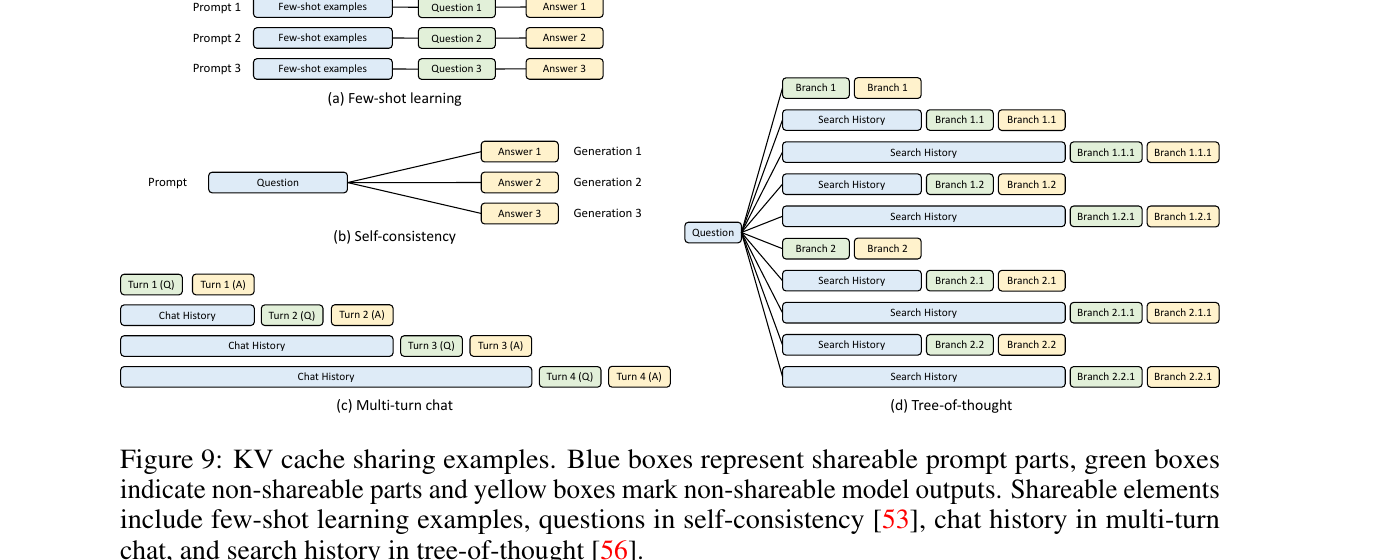
Figure 9 (from the paper). Blue = shareable prompt parts, green = non-shareable inputs, yellow = non-shareable model outputs. (a) Few-shot learning shares the example block across many questions; (b) self-consistency shares one question across many samples; (c) multi-turn chat makes each turn’s history a prefix of the next; (d) tree-of-thought shares search history down each branch. None of the existing systems could automatically handle all of these — RadixAttention can. [Paper] These map straight onto the reasoning workloads I studied earlier — self-consistency, chain-of-thought, and ReAct agents. [Interpretation]
V. RadixAttention: Automatic KV Cache Reuse
RadixAttention is the paper’s headline runtime technique: automatic and systematic KV cache reuse during runtime. [Paper] Instead of discarding the KV cache when a request finishes, SGLang retains it in an LRU cache organized as a radix tree, enabling efficient prefix search, reuse, insertion, and eviction. [Paper]
Why a radix tree
A radix tree is a space-efficient trie: its edges can be labelled with sequences of tokens of varying length, not just single tokens, which keeps the tree shallow and matching fast. [Paper] SGLang uses it to map sequences of tokens → their KV cache tensors. Crucially, those KV tensors are stored in a non-contiguous, paged layout where each page holds one token — the same paged idea as vLLM’s PagedAttention, which lets the cache grow and be evicted at token granularity without fragmentation. [Paper] [Interpretation]
flowchart TB
    START(["New request:<br/>token sequence arrives"]) --> MATCH

    subgraph LOOKUP["🔎 Prefix match (radix tree)"]
        MATCH["match_prefix(input_tokens)<br/>walk tree, follow longest<br/>matching edges"]
        MATCH --> HIT{"matched<br/>prefix length p ?"}
    end

    HIT -->|"p > 0 — cache hit"| REUSE["Reuse cached KV for first p tokens<br/>(bump node reference counter)"]
    HIT -->|"p = 0 — miss"| ROOTS["Start from root"]

    REUSE --> PREFILL["Prefill only tokens p .. n<br/>(the uncached remainder)"]
    ROOTS --> PREFILL

    PREFILL --> DECODE["Decode output tokens<br/>autoregressively"]
    DECODE --> INSERT["Insert new path into tree<br/>split nodes where prefixes diverge<br/>decrease reference counter on finish"]
    INSERT --> EVICT{"GPU memory<br/>pressure?"}
    EVICT -->|"yes"| LRU["Evict least-recently-used LEAF<br/>with ref counter = 0"]
    EVICT -->|"no"| DONE(["Done — KV stays cached<br/>for future reuse"])
    LRU --> DONE

    classDef startCls fill:#f1f5f9,stroke:#475569,color:#0f172a;
    classDef lookupCls fill:#dbeafe,stroke:#2563eb,color:#1e3a8a;
    classDef reuseCls fill:#dcfce7,stroke:#16a34a,color:#14532d;
    classDef compCls fill:#ffedd5,stroke:#ea580c,color:#7c2d12;
    classDef evictCls fill:#fee2e2,stroke:#dc2626,color:#7f1d1d;
    class START,DONE startCls;
    class MATCH,HIT lookupCls;
    class REUSE,ROOTS reuseCls;
    class PREFILL,DECODE,INSERT compCls;
    class EVICT,LRU evictCls;
    style LOOKUP fill:#eff6ff,stroke:#2563eb,stroke-width:2px;
The RadixAttention lifecycle for a single request: match → reuse → prefill-the-rest → decode → insert → maybe-evict. [Interpretation]
LRU eviction with reference counting
Two design decisions make this safe under real serving: [Paper]
- Evict leaves first (LRU). GPU memory fills quickly, so SGLang evicts the least-recently-used leaf first. Evicting leaves before their ancestors means shared ancestors (e.g. a system prompt) survive until they themselves become unused leaves. [Paper]
- Reference counting for the running batch. In a continuous-batching setting you cannot evict cache that a running request is still using. Each node carries a reference counter of how many running requests use it; a node is evictable only when its counter is zero. [Paper]
There is also a memory decision that surprised me and is worth calling out: SGLang does not preallocate a fixed cache pool. The cached tokens and the currently running requests share the same memory pool. [Paper] So the system dynamically trades cache for batch size: when enough waiting requests are ready to run, it will evict all cached tokens in favour of a larger batch. [Paper] Cache is a tenant of the same memory, not a walled-off region — which is exactly why the eviction policy has to be this careful. [Interpretation]
Watching the tree evolve
Figure 3 is the figure to actually study, because it shows insertion, node splitting, and eviction happening on a live tree across nine time points:
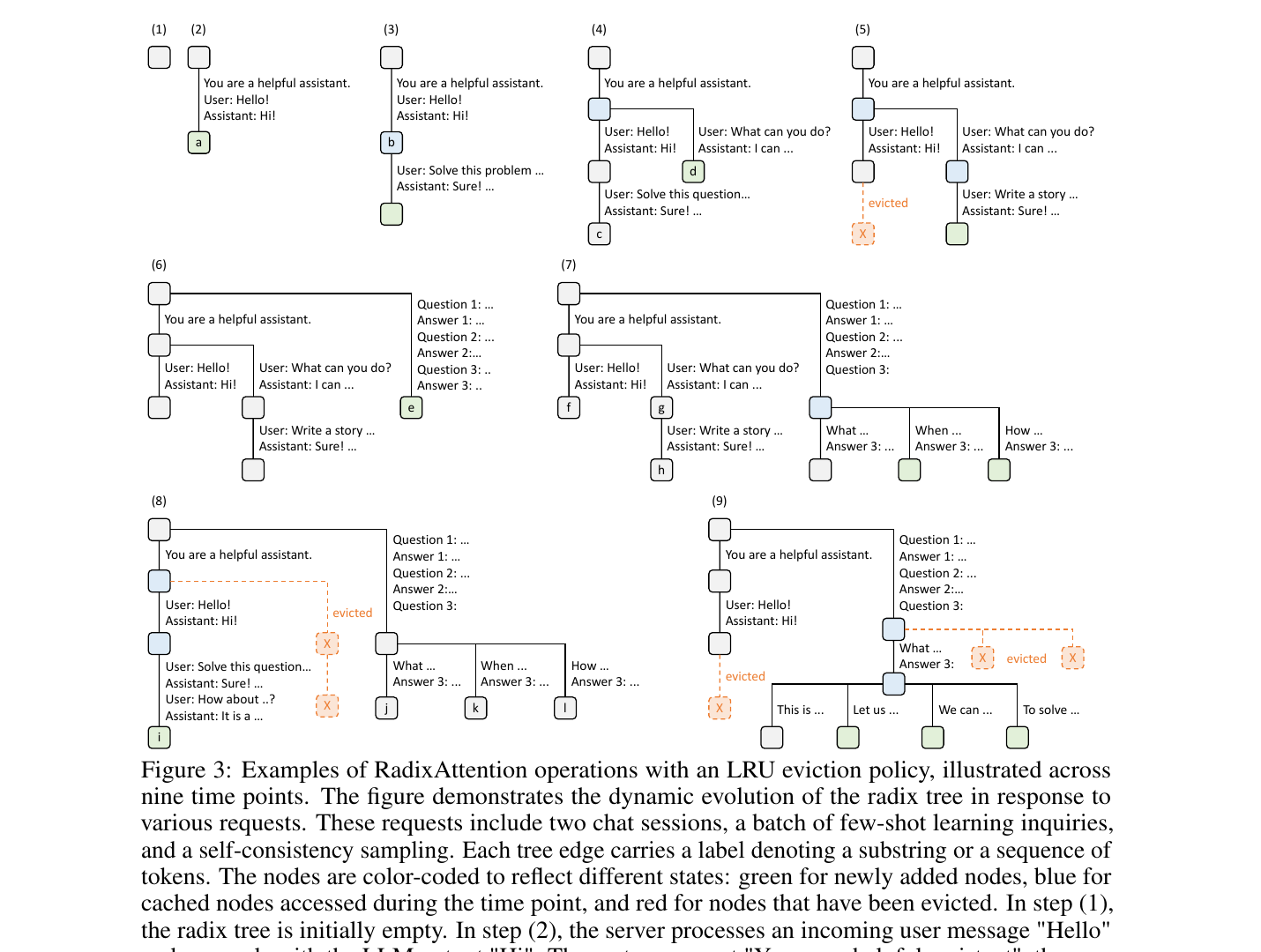
Figure 3 (from the paper). Green = newly added nodes, blue = cached nodes accessed at this step, red (dashed X) = evicted. (1) empty tree. (2) first chat turn (“You are a helpful assistant” + “Hello!” + “Hi!”) becomes one edge. (3) a new prompt reuses that first turn’s KV and appends a node. (4) a second chat session begins, so the shared system-prompt node is split so two sessions can branch off it. (5) memory pressure forces the LRU eviction of node “c”. (6) a batch of few-shot queries arrives — the root splits because the new query shares no prefix. (7) more few-shot queries sharing the same examples split node “e” to enable sharing. (8)–(9) self-consistency sampling reuses a node many times while the least-recently-used chat nodes get evicted to make room. [Paper]
The node splitting in step (4) is the mechanism that makes partial prefix sharing work: when a new sequence agrees with an existing edge for only part of its length, the edge is split at the divergence point so the shared part stays a single reusable node. [Paper] [Interpretation]
Frontend–runtime co-design: the “frontend hint”
Here is where the two halves of SGLang stop being independent. During a fork, the interpreter sends the shared prefix to the runtime first, as a hint, so it is guaranteed to be inserted into the radix tree before the diverging branches arrive. Then it sends the remaining prompts. [Paper] The tree is stored on the CPU with negligible maintenance overhead. [Paper]
This “frontend hint” is small but telling: the frontend knows the structure of the program (these branches share a parent), and passing that structure down lets the runtime match and schedule better than it could by inference alone. [Interpretation] The ablation later confirms it matters.
VI. Cache-Aware Scheduling and Continuous Batching
A radix tree of cached prefixes is only half the win. The order in which you run the waiting requests decides how much of that cache you actually hit. [Paper]
The cache hit rate, and why order matters
The paper defines the cache hit rate simply: [Paper]
\[\text{cache hit rate} = \frac{\text{number of cached prompt tokens}}{\text{number of prompt tokens}}\]If the scheduler keeps switching between unrelated requests, it thrashes the cache and the hit rate collapses. [Paper] So instead of first-come-first-served, SGLang sorts waiting requests by matched prefix length and runs the longest-shared-prefix-first. [Paper]
The optimality result
The paper proves this greedy order is not just a heuristic — it is optimal in the batch (offline) setting: [Paper]
Theorem 3.1. For a batch of requests, we can achieve an optimal cache hit rate by visiting the radix tree of the requests in depth-first search (DFS) order, with a cache size $\geq$ the maximum request length. The longest-shared-prefix-first order is equivalent to a DFS order. [Paper]
The intuition behind the proof is clean. If you visit the tree in DFS order, each edge’s KV cache is computed exactly once: the first time you reach edge $e$ you compute it, then you finish its whole subtree while $e$ stays continuously “hit” (so it is never evicted, given enough cache), and you never return to it. [Paper] That gives the lower bound on total computation $C$: [Paper]
\[C = \sum_{e \,\in\, \text{edges}(T)} |e|\]| where $ | e | $ is the number of tokens on edge $e$. Plugging that into the hit-rate definition, the achievable hit rate reaches its upper bound: [Paper] |
In the online case the DFS order gets disrupted by arrivals, but the longest-shared-prefix schedule still approximates DFS on the newly-added part of the tree. [Paper] The honest caveat the authors flag: greedy cache-aware scheduling can cause starvation, and integrating it with fair scheduling is left as future work. [Paper]
Putting it together with continuous batching
The scheduler runs inside a continuous batching loop — new sequences join the running batch as others finish, keeping the GPU busy. Algorithm 1 in the paper ties matching, sorting, admission, memory allocation, eviction, and insertion into one cycle: [Paper]
Algorithm 1 — Cache-Aware Scheduling for RadixAttention with Continuous Batching
Input:  radix tree T, memory pool P, current running batch B, waiting queue Q

requests ← Q.get_all_requests()
for req in requests:                                  # match every waiting request
    req.prefix_node, req.prefix_len ← T.match_prefix(req.input_tokens)
requests.sort()                                       # longest matched prefix first

available_size ← T.evictable_size() + P.available_size()
current_size   ← 0
new_batch      ← []
for req in requests:                                  # admit until memory runs out
    if req.size() + current_size < available_size:
        new_batch.append(req)
        delta ← T.increase_ref_counter(req.prefix_node)   # protect reused nodes
        current_size ← current_size + delta
Q.remove_requests(new_batch)
B.merge(new_batch)

needed_size ← B.needed_size()                         # allocate, evicting if needed
success, buffer ← P.alloc(needed_size)
if not success:
    T.evict(needed_size)                              # LRU eviction of unused leaves
    success, buffer ← P.alloc(needed_size)
B.run(buffer)

finished_requests ← B.drop_finished_requests()
for req in finished_requests:
    T.decrease_ref_counter(req.prefix_node)           # release, and…
    T.insert(req)                                     # …insert its KV for future reuse
return finished_requests
flowchart LR
    Q["📥 Waiting queue Q"] --> M["match_prefix<br/>for all requests"]
    M --> S["sort by matched<br/>prefix length ↓"]
    S --> A["admit into batch<br/>while memory available<br/>++ref counters"]
    A --> AL{"P.alloc<br/>succeeds?"}
    AL -->|"no"| EV["T.evict()<br/>LRU unused leaves"] --> A2["retry alloc"]
    AL -->|"yes"| RUN["B.run()"]
    A2 --> RUN
    RUN --> FIN["drop finished<br/>--ref counters<br/>insert KV into tree"]
    FIN --> Q

    classDef qCls fill:#dbeafe,stroke:#2563eb,color:#1e3a8a;
    classDef opCls fill:#dcfce7,stroke:#16a34a,color:#14532d;
    classDef evCls fill:#fee2e2,stroke:#dc2626,color:#7f1d1d;
    classDef runCls fill:#ffedd5,stroke:#ea580c,color:#7c2d12;
    class Q,M,S qCls;
    class A,A2,FIN opCls;
    class EV evCls;
    class RUN,AL runCls;
The continuous-batching loop. Every finished request feeds its KV back into the tree, so the cache is continuously refreshed by the workload itself. [Interpretation] RadixAttention is compatible with continuous batching, paged attention, and tensor parallelism, and adds negligible overhead — more on the exact number in the evaluation. [Paper]
VII. Distributed RadixAttention
The scheme extends to multiple GPUs without much ceremony: [Paper]
- Tensor parallelism. Each GPU keeps a sharded KV cache. No extra synchronization is needed because the tree operations are identical on every shard. [Paper]
- Data parallelism. With multiple replica workers, a router oversees a meta-tree — a trie tracking which sub-trees live on which worker — and does prefix matching on the meta-tree to dispatch each batch to the worker with the best affinity (longest shared prefix). Router and workers update their trees independently; evictions are queued to the router and applied during low activity. On four workers over MMLU this achieves linear scaling with an optimal cache hit rate under a weakly-consistent design. [Paper]
VIII. Compressed Finite State Machine: Faster Constrained Decoding
The second runtime optimization tackles the JSON/regex case. Users constrain output to a format (a JSON schema) via the regex argument; the system compiles that regex into a finite state machine (FSM) and, during decoding, keeps the current FSM state and masks out tokens that would violate the next transition. [Paper]
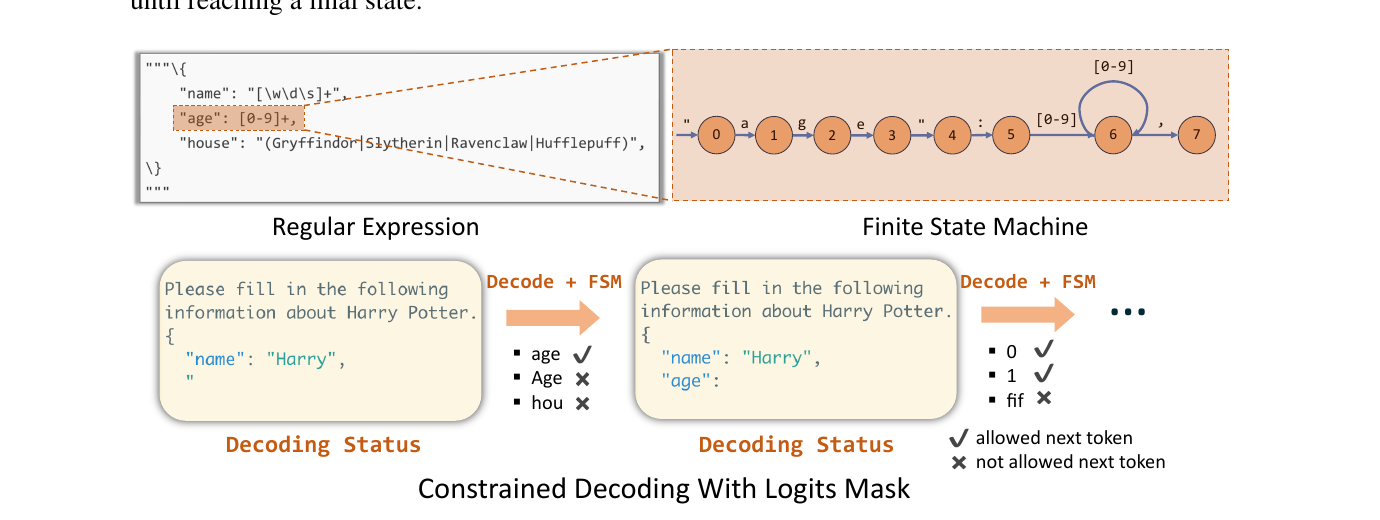
Figure 10 (from the paper, appendix). The base mechanism: a regex (here a Harry-Potter JSON schema) compiles into an FSM whose states and edges encode which characters are legal next. At each decoding step the FSM’s current state defines an allowed set, and every token outside it is masked out of the logits (age ✓, Age ✗, hou ✗). The catch the paper highlights: constraints are expressed over characters/strings, but the model decodes tokens, and there is no clean one-to-one mapping between them. [Paper]
The inefficiency: existing systems only ever apply this mask one token at a time, so even a stretch of text that is completely forced — like the literal {"summary": " at the start of the schema — is decoded token by token, one forward pass each. [Paper]
SGLang’s fix is a compressed FSM. It analyzes the FSM and compresses adjacent singular-transition edges into a single edge, so the runtime can recognize when a run of tokens is forced and decode them all in one forward pass. [Paper]
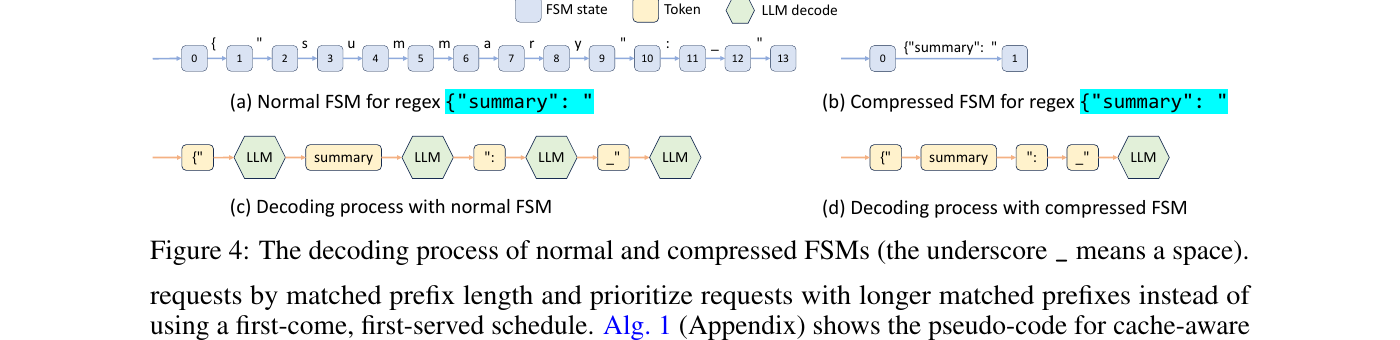
Figure 4 (from the paper). (a) The normal FSM for {"summary": " needs 13 states — one transition per character. (b) The compressed FSM collapses that whole forced run into a single edge. (c) Decoding with the normal FSM takes multiple LLM forward passes even though only one continuation is ever valid. (d) Decoding with the compressed FSM emits the forced multi-token span in a single forward pass, then only calls the model where the output genuinely branches (the actual summary text). [Paper]
Two implementation details from Appendix B make this robust: the FSM is built over characters/strings, not tokens, then singular edges are recursively merged; and because the model’s tokenizer doesn’t align to character boundaries, a retokenization / “jump forward” step reconciles the forced string with the model’s token vocabulary. [Paper] The payoff, quantified later, is a 1.6× throughput gain on JSON decoding. [Paper]
IX. API Speculative Execution
The third optimization is for API-only models (e.g. GPT-4/GPT-3.5) where you cannot touch the KV cache or the FSM at all. [Paper]
Consider a program that fills a template with two fields:
s += context + "name:" + gen("name", stop="\n") + "job:" + gen("job", stop="\n")
Naively, the two gen calls are two API calls, and you pay the input-token fee for context twice. [Paper] SGLang instead enables speculative execution: on the first call it ignores the stop condition and lets the model continue generating a few more tokens; the interpreter keeps those extra outputs and, if a later primitive matches them, reuses them — saving both the latency and the input cost of a second API call. [Paper] With careful prompt engineering the model often continues the template correctly, so the speculation lands. [Paper]
X. The Life of a Request (End-to-End Walkthrough)
Stitching the pieces together, here is what actually happens when an SGLang program runs on SRT: [Interpretation] [Paper]
- The application writes an SGLang program; the interpreter streams its primitives asynchronously, forking where the program forks and emitting frontend hints for shared prefixes. [Paper]
- Each request reaches the runtime and is matched against the radix tree to find its longest cached prefix. [Paper]
- The cache-aware scheduler sorts the waiting requests longest-shared-prefix-first and admits as many as memory allows, bumping reference counters on reused nodes. [Paper]
- For each admitted request, only the uncached remainder is prefilled; the cached prefix’s KV is reused directly. [Paper]
- If the output is constrained, the compressed FSM decodes forced spans in single forward passes. [Paper]
- Decoding proceeds under continuous batching; finished requests release their reference counts and insert their KV back into the tree for future reuse. [Paper]
- Under memory pressure, LRU eviction frees unused leaves — possibly evicting all cache to make room for a bigger batch. [Paper]
The chain the whole system is built to exploit: [Interpretation]
structured program → visible shared prefixes → RadixAttention reuse → less redundant prefill → larger batches for the same memory → higher GPU utilization → more throughput at lower latency.
XI. Does It Actually Work? The Evaluation
When I read the results I kept three questions in mind: does reuse actually raise throughput and cut latency, which mechanism causes the win on each workload, and what does it cost. [Interpretation]
Setup
SGLang is implemented in PyTorch with custom CUDA kernels from FlashInfer and Triton. [Paper] Models span dense (Llama-2 7B/70B), MoE (Mixtral-8×7B), multi-modal (LLaVA image, LLaVA-NeXT-34B video), and an API model (GPT-3.5). [Paper] Hardware is mostly AWS EC2 G5 (A10G 24GB) — 7B on a single A10G, larger models on multiple A10Gs with tensor parallelism — plus some A100 (80GB) runs. [Paper]
The baselines are chosen so the comparison is fair, not a strawman: Guidance v0.1.8 (llama.cpp), vLLM v0.2.5 (its default API server), and LMQL v0.7.3 (HF Transformers). Critically, the authors do not enable any optimization that would change the computed results, so all systems compute the same thing. [Paper] Two metrics: throughput (programs/second under a large batch) and latency (a single program, no batching). [Paper]
End-to-end throughput and latency
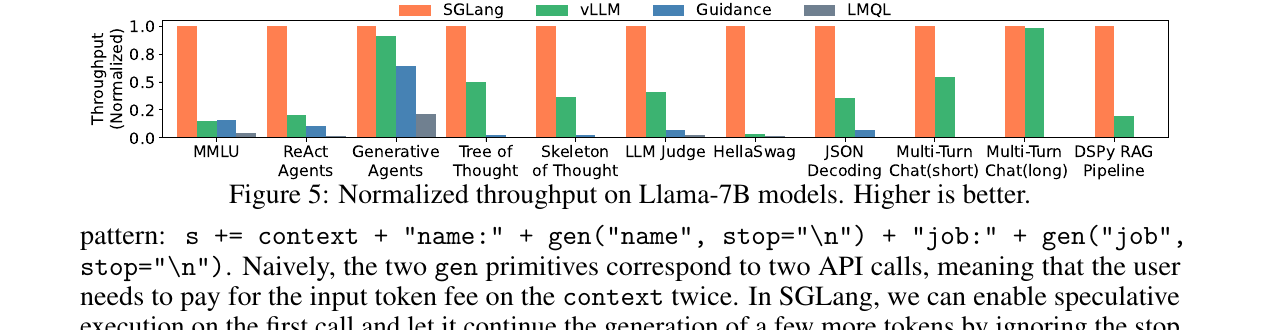
Figure 5 (from the paper). Normalized throughput on Llama-7B (higher is better). SGLang is at or near 1.0 on every workload; the baselines trail badly on agent, reasoning, JSON, and multi-turn tasks. [Paper]
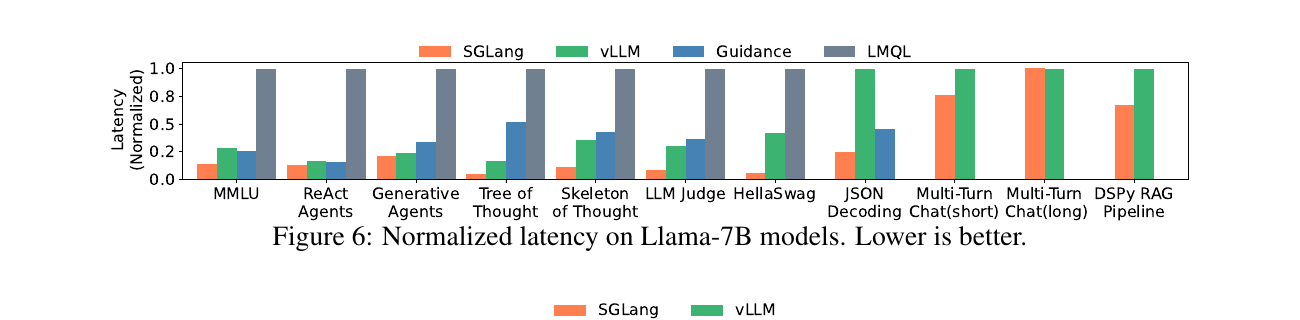
Figure 6 (from the paper). Normalized latency on Llama-7B (lower is better). LMQL (grey) is consistently the slowest; SGLang (orange) is lowest except where decode time dominates. [Paper]
Across these workloads SGLang improves throughput by up to 6.4× and reduces latency by up to 3.7×. [Paper] The gains come from three sources working together: KV cache reuse, intra-program parallelism, and faster constrained decoding. [Paper] The per-benchmark reasons are the interesting part, because they show which mechanism fires: [Paper]
- MMLU — reuse the KV cache of the 5-shot examples; smaller memory footprint also allows a larger batch, and reuse cuts prefill so first-token latency drops.
- HellaSwag — two-level sharing: reuse the few-shot examples and the common question prefix across the multiple-choice options.
- ReAct / generative agents — reuse the agent template and previous calls.
- Tree-of-thought / skeleton-of-thought — parallelize the branches within one program and reuse as much KV as possible.
- JSON decoding — decode multiple tokens at once via the compressed FSM.
- Multi-turn chat — reuse the chat history. The speedup is larger for short outputs (reuse mostly helps the prefill); for long outputs decoding dominates and there is little cross-session sharing, so almost no speedup.
- DSPy RAG pipeline — reuse the KV cache of the common context example.
Across these, the achieved cache hit rate ranges from 50% to 99%, and the cache-aware scheduler reaches ~96% of the optimal hit rate on average (Figure 13, appendix). [Paper] The honest note: LMQL and Guidance are excluded from some benchmarks because of slow token-level processing and missing features (Guidance lacks batching and parallelism). [Paper]
It generalizes to larger models
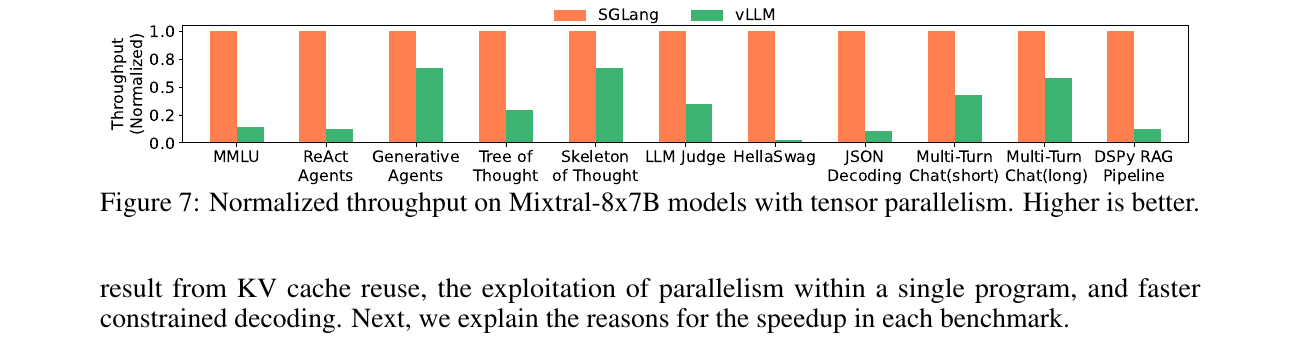
Figure 7 (from the paper). Normalized throughput on Mixtral-8×7B with tensor parallelism (higher is better). The same pattern as the 7B results holds, so the optimizations generalize to a larger MoE model. Guidance and LMQL are omitted here because they lack efficient tensor-parallel implementations. [Paper] Llama-70B shows a similar trend (Figure 12, appendix). [Paper]
Multi-modal models
RadixAttention extends to images: SGLang hashes the input image and uses that hash as the key in the radix tree, so the KV cache of image tokens is reused across requests about the same image. [Paper]

Table 2 (from the paper). On LLaVA-v1.5-7B (image) SGLang lifts throughput from 0.18 → 1.15 image/s, and on LLaVA-NeXT-34B (video) from 0.02 → 0.10 frame/s — up to 6× — versus the model authors’ original HF Transformers implementation. On llava-bench-in-the-wild, where multiple questions target the same image, image-KV reuse is exactly what pays off. [Paper]
Ablation: which components matter
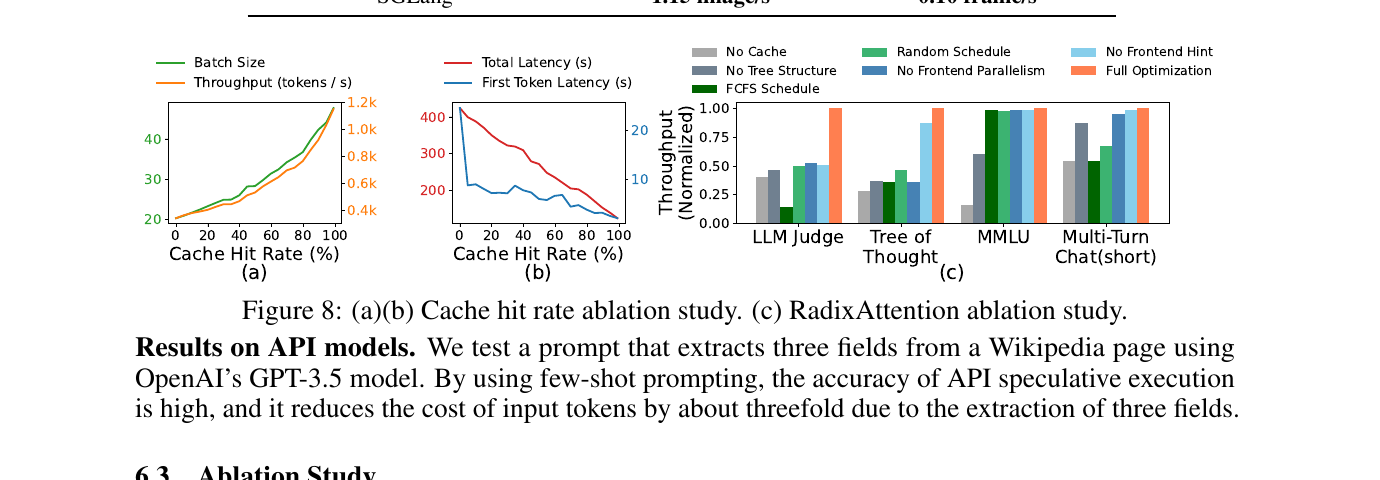
Figure 8 (from the paper). (a)(b) On tree-of-thought, as the cache hit rate rises (by disabling matched tokens at runtime), batch size and throughput go up and both total and first-token latency go down — a clean, monotone relationship confirming reuse is the lever. (c) The per-component RadixAttention ablation: No Cache, No Tree Structure (a flat table cache instead of a tree), FCFS Schedule, Random Schedule, No Frontend Parallelism, and No Frontend Hint each fall short of Full Optimization. [Paper]
Ablation (c) is the strongest evidence for the paper’s co-design thesis: removing the tree structure, the cache-aware schedule, the frontend parallelism, or the frontend hint each degrades throughput. [Paper] The frontend hint mattering is the concrete proof that frontend–runtime co-design isn’t decoration — the runtime genuinely schedules better when the language passes down what it knows about program structure. [Interpretation]
What it costs
The overhead question is answered directly. On ShareGPT — a workload with essentially no reuse opportunities — 100 requests take 74.3s, of which managing the RadixAttention data structures is only 0.2s: under 0.3%. [Paper] Because the tree operations are linear and small, RadixAttention is safe to leave on by default. [Paper] For the compressed FSM, JSON throughput rises 1.6×; the FSM preprocessing is reused across a batch, and skipping that reuse (redoing preprocessing per request) would make throughput 2.4× lower. [Paper]
It runs in production
SGLang was deployed on Chatbot Arena. After one month, the observed RadixAttention cache hit rate was 52.4% for LLaVA-Next-34B and 74.1% for Vicuna-33B, with hits coming from shared system messages, frequently-reused example images, and multi-turn histories — reducing first-token latency by an average of 1.7× for Vicuna-33B. [Paper] On the API side, extracting three fields from a Wikipedia page via GPT-3.5 with speculative execution cuts input-token cost by about threefold. [Paper]
XII. Where SGLang Sits (Related Work)
Plenty of systems reuse KV cache; the paper is careful about what is genuinely new. [Paper]
- RadixAttention is the first to treat the KV cache as a tree-based LRU cache, and the first to support multi-level sharing, cache-aware scheduling, frontend–runtime co-design, and distributed cases together. [Paper]
- vLLM and ChunkedAttention explore simple reuse (e.g. system-prompt sharing) but not multi-level tree-structured sharing or LRU caching. [Paper]
- PromptCache reuses cache beyond the strict prefix (modular reuse) but can hurt accuracy by up to 43%. [Paper]
- HydraGen, FlashInfer, ChunkedAttention focus on CUDA-kernel optimizations for shared prefixes but do not include an LRU cache concept. [Paper]
- Among languages/frameworks — Guidance, LMQL, DSPy, LangChain, AutoGen, LLM Compiler — Guidance and LMQL are the closest; SGLang’s contribution is the novel runtime, and it stays compatible with the others (it even backs DSPy). [Paper] (See also the LLM Compiler for a different take on parallelizing multi-call programs.)
The clean way to place it against the serving systems I studied: [Interpretation]
- vLLM / PagedAttention — manage KV memory within a node without fragmentation.
- MOONCAKE — pool and move KV across a cluster (global cache, P/D disaggregation).
- SGLang / RadixAttention — avoid creating redundant KV in the first place, by reusing shared prefixes and scheduling around them. MOONCAKE’s own related-work section, in fact, cites SGLang/RadixAttention as the prefix-reuse line it builds on. [Paper]
XIII. Limitations and Future Directions
The paper is candid about what is left open: [Paper]
- Cache-aware scheduling can starve requests with no shared prefix; integrating it with fair scheduling is future work.
- RadixAttention currently lives in GPU memory; extending it across the memory hierarchy (DRAM, disk) is future work — which is precisely the gap that hierarchical-cache systems fill.
- Fuzzy semantic matching within RadixAttention (reusing near-duplicate, not just identical, prefixes) is unexplored.
- Higher-level primitives atop SGLang, and a stronger compiler for static scheduling and memory planning, are proposed extensions.
XIV. My Engineering Takeaway
What makes SGLang stick for me is the framing, not any single trick. [Interpretation] The paper reframes LLM serving for LM programs as a KV-cache reuse problem, and then insists that reuse only fully pays off when the language and the runtime are designed together: the frontend exposes structure (fork, shared prefixes, regex), and the runtime turns that structure into cache hits (RadixAttention), better batches (cache-aware scheduling), and fewer forward passes (compressed FSM).
Placed next to the other serving systems, it completes a layered picture of the KV-cache lifecycle: don’t create redundant KV (SGLang), store it without fragmentation (vLLM), and move it across the cluster when you must (MOONCAKE). [Interpretation] Stacking these ideas — rather than simply buying more compute — is, I think, the actual path to cheaper inference. And the sub-0.3% overhead means the first of those wins is essentially free to turn on. [Interpretation]