Fig. 06 — Signal dossier / 2026.10
Training Agents at the Frontier of AI Industry
Frontier labs train LLM agents with reinforcement learning in sandboxed environments. Enterprises pay for one thing: a measurable business outcome.
- Published
- 29 Oct 2026signal no. 06
- Category
- Agentic RLfield note
- Read time
- 23 min~4966 words
- Topics
- AI Agents+ 3 more
- Author
- Trisham Patilindependent reading
Filed 2026-10-29 Signal no. 06Agentic RL Read time: 23 min
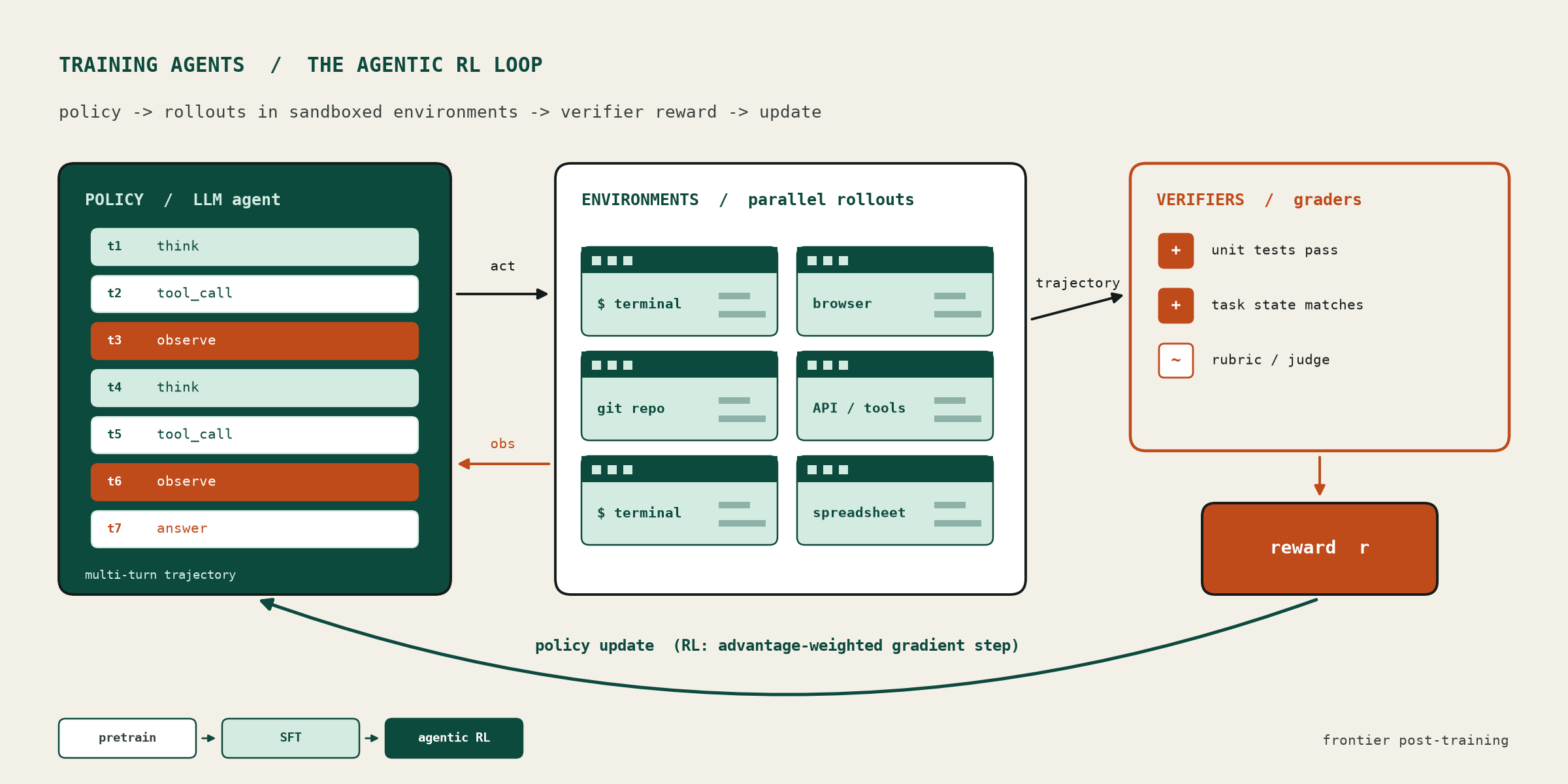 The agentic RL loop: the policy acts in sandboxed environments, verifiers score each trajectory, and the reward updates the policy. Drawn for this post.
Enterprise RL
Customers Pay for Business Outcomes
What we assume they want
Better RL numbers
- A higher reward score
- A better benchmark ranking
- The newest RL algorithm
What they actually pay for
ROI on one business metric
- Higher throughput: more tasks completed per unit of time
- Better decisions: higher success rates and fewer costly mistakes
- Lower operating costs: reduced compute, energy and human intervention
- Safe, reliable execution: actions that respect business constraints and operational policies
Enterprise RL is valuable when it improves a measurable business outcome, not merely when it achieves a higher reward.
Why Business KPIs Are Hard to Hit with Enterprise Agents
01 / Tools
Many tools, and they fail
- Tens to 100+ tools per agent
Common failure modes
- Timeouts
- Stale data
- Conflicting sources
- Wrong tool
02 / Latency
Most time goes to the system
Time to first token is affected by
- Model planning
- Customer API calls
- Searching documentation
- Database queries
- Network faults and retries
- Model choosing the next step
What helps
- Parallel calls
- Caching
- Materialized views
- Retry budgets
03 / Safety
Safety lives around the model
External dependencies
- Tools
- Data
- People
- Network
Essential controls
- Sandbox
- Allowlist
- Policy checks
- Human approval
- Audit log
- Kill switch
Enterprise RL: What Customers Actually Pay For
The business implication: customers don’t pay for agents that merely reason well. They pay for agents that reliably improve business KPIs.
| What customers need | Business outcome |
|---|---|
| Reliable tool use | Higher task completion rate |
| Low-latency execution | Faster case resolution |
| Accurate, fresh data | Fewer costly errors |
| Safe, controlled actions | Lower operational risk |
| Efficient orchestration | Lower cost per successful task |
| Continuous learning and optimization | Improved business KPI over time |
Key takeaway: Enterprise RL must optimize the entire system (decision quality, execution reliability, latency, cost and safety), not just the model’s reward score.
Building an Evaluation-Driven Optimization Loop for Enterprise Agents
The right way to approach enterprise RL is to build an evaluation-driven optimization loop for the agentic system first. Then introduce reinforcement learning only when you have a reliable reward signal and enough representative trajectories.
Take a typical enterprise stack: AWS Bedrock Runtime models, DSPy, asyncio, LangGraph, Langfuse and CloudWatch. With it, the problem separates into three layers.
Layer 01 / Evaluate
The business outcome
Did the agent resolve the case, use correct information, follow policy and achieve the target KPI?
Layer 02 / Optimize
The agent
Improve prompts, DSPy modules, tool selection, graph routing, retries and context construction based on evaluation results.
Layer 03 / Learn
From trajectories
Capture state, actions, tool results, intermediate decisions, final outcomes and rewards. Use them to train or optimize the policy where the chosen model and training infrastructure support it.
One crucial distinction: changing prompts based on evaluation results is not, by itself, reinforcement learning. DSPy optimization, supervised fine-tuning and RL are different techniques. Build the evaluation and trace infrastructure first, so any later optimization is measurable and does not overfit the held-out dataset.
The Resources I Would Use for Enterprise Agent Optimization
These are the most relevant official docs and open-source projects for this stack.
01 / Best starting point for RL research
Agent Lightning: agent-level RL
Collects agent trajectories and reward signals, then connects agent execution to RL training infrastructure. Relevant to multi-step agents and existing orchestration frameworks. Its training stack (verl, on your own GPUs) is separate from Bedrock Runtime.
The repository ships an Agent Lightning Skill that helps a coding agent improve another agent against a benchmark. Check the current install instructions and compatibility before adopting it.
02 / Optimize prompts using traces
DSPy GEPA
Uses evaluation metrics and textual feedback from failures to improve prompts and multi-module programs. It is the most natural first optimization stage for this stack.
GEPA can use rich feedback about incorrect outputs, tool failures and constraint violations, rather than relying only on a numerical score.
03 / Traces and evaluation datasets
Langfuse
Use it to compare versions, capture nested LangGraph traces, score runs, build datasets from failures and run offline experiments.
Documentation · LangGraph integration · Datasets and experiments
04 / Actual model-weight updates
Amazon Bedrock Reinforcement Fine-Tuning
AWS-managed RL fine-tuning (GRPO) for supported models, with custom reward functions in Lambda or a model-as-judge grader. It is not available for every model you can invoke through Bedrock Runtime.
At the time of writing, the docs list Amazon Nova 2 Lite (us-east-1), gpt-oss-20B and Qwen3 32B (us-west-2). Check the live support matrix before designing the training pipeline.
Official RFT documentation · Training data format · AWS best practices
How I Would Structure the Agent Optimization Loop
flowchart TD
    D["Business task + versioned dataset"] --> P["Training / development · validation · sealed holdout"]
    P --> X["Agent execution<br/>Bedrock Runtime → DSPy → LangGraph tools and async workflows"]
    X --> T["Trace + reward collection<br/>Langfuse traces · CloudWatch metrics · task outcomes · tool events"]
    T --> A["Stage A: Optimize<br/>DSPy GEPA / MIPRO · prompt changes · routing and retrieval improvements"]
    T --> B["Stage B: Train<br/>SFT or RL with a compatible trainable model and training backend"]
    A --> V["Compare candidates on unseen validation data"]
    B --> V
    V --> H["Run the sealed holdout once for final confirmation"]
    H --> R{"Business KPIs improve<br/>without safety regressions?"}
    R -->|"yes"| S["Release"]
    R -->|"no"| X
A few important design decisions:
- Don’t tune on your held-out test set. Use development data to optimize, validation data to choose candidates and a sealed holdout to estimate generalization.
- Keep model, prompt, graph, tool and reward versions together. Otherwise a higher score might come from a code or tool change rather than from learning.
- Measure the whole workflow. A correct final answer is not enough if the agent used a prohibited tool, exceeded its latency budget or caused an incorrect business action.
- Treat the trace as evidence, not automatically as training data. A trace becomes useful for RL only after you define the decision/action representation, a valid reward signal and an appropriate training objective.
The Master Prompt for Claude Code
Copy this prompt into Claude Code. It tells Claude Code to inspect the existing repository first, preserve the stack, implement an evaluation and trace pipeline, and work out which RL method is genuinely compatible with your Bedrock models.
Master Engineering Task: Build an Evaluation-Driven Enterprise Agent Optimization and RL Pipeline

ROLE
Act as a Staff AI Systems Engineer, Reinforcement Learning Research Engineer, and ML Platform Engineer.

I am building production-grade agentic AI systems for enterprise business use cases. I want to
systematically improve business outcomes by evaluating agents on held-out datasets, analyzing
execution traces, optimizing prompts and workflows, and eventually applying reinforcement
learning to compatible models.

Do not build a toy demonstration. Inspect the existing repository, identify the actual
architecture, and implement an incremental, testable optimization framework that integrates
with the current codebase.

1. EXISTING TECHNOLOGY STACK
My existing stack includes:
- AWS Bedrock Runtime for foundation model inference.
- Python and asyncio for asynchronous execution.
- LangGraph for stateful agent orchestration and multi-step workflows.
- DSPy for prompt and program optimization.
- Langfuse for tracing, prompt versioning, datasets, experiments, and evaluations.
- AWS CloudWatch for operational logging, metrics, latency, failures, and infrastructure monitoring.

Preserve these technologies wherever possible. Do not replace the existing architecture merely
to accommodate a new framework.

Use typed Python, Pydantic schemas, structured logging, pytest, configuration management, and
asynchronous I/O where appropriate.

2. FIRST INSPECT THE REPOSITORY
Before modifying any code:
1. Inspect the repository tree, README, pyproject.toml or requirements files, configuration,
   entry points, LangGraph definitions, DSPy modules, Bedrock clients, tool integrations, tests,
   and existing Langfuse instrumentation.
2. Identify the current model IDs, AWS Regions, inference APIs, model invocation patterns, and
   whether the system uses a direct Bedrock Runtime API or an OpenAI-compatible endpoint.
3. Determine how prompts, graph state, tools, retries, timeouts, and business outcomes are
   currently represented.
4. Identify which LangGraph nodes contain model decisions and which contain deterministic
   business logic.
5. Identify existing traces, evaluation datasets, test fixtures, and operational metrics.
6. Produce an architecture assessment and an implementation plan before making significant changes.

Do not assume that all models support fine-tuning, log probabilities, token-level training
data, or gradient updates.

3. DEFINE THE BUSINESS OBJECTIVE
Design the system around measurable business outcomes rather than generic model quality.

Create a configurable task-specific reward interface that can evaluate:
- End-to-end task completion.
- Correctness against reference answers or business-system state.
- Compliance with business policies and constraints.
- Tool selection and tool-call success.
- Data grounding and factual consistency.
- Latency, including end-to-end latency and time to first token where applicable.
- Cost per successful task.
- Retry counts and failure rates.
- Human intervention requirements.
- Safety violations and unauthorized actions.

Use task-specific evaluators wherever possible. Use an LLM judge only for dimensions that cannot
be reliably evaluated through deterministic checks.

Do not use a generic reward that treats all tasks alike.

Make reward weights configurable per business use case. Normalize component scores and document
the reward scale.

Implement hard safety constraints separately from the aggregate reward. A high task-completion
score must never compensate for a critical policy violation.

Do not reward verbosity, extra tool calls, or longer reasoning unless they demonstrably improve
the business outcome.

4. IMPLEMENT A DATASET MANAGEMENT AND EVALUATION FRAMEWORK
Support the following dataset partitions:
- Training/development: prompt optimization and training-data construction.
- Validation: candidate selection and hyperparameter tuning.
- Sealed holdout: final generalization measurement.

Ensure the same examples cannot silently leak across partitions.

Define a typed evaluation example containing, as appropriate:
- Stable example ID.
- Business task and input.
- Expected output or reference criteria.
- Expected business-state transition.
- Permitted tools and actions.
- Policy constraints.
- Relevant metadata.
- Dataset version and partition.

Support importing examples from JSONL and, where appropriate, Langfuse datasets.

Implement a reproducible experiment runner that can execute a selected agent version against a dataset.

For every run, record:
- Dataset and example IDs.
- Agent code commit.
- Model provider, model ID, and Region.
- Prompt version and DSPy configuration.
- LangGraph configuration and tool versions.
- Sampling parameters.
- Evaluator and reward-function versions.
- Start/end time and execution status.
- Final output and business outcome.
- Latency, token usage where available, and cost where measurable.
- Trace IDs and failure details.

Use deterministic settings where supported. Where the provider is nondeterministic, measure
variability through repeated runs on a predefined subset.

5. INSTRUMENT COMPLETE AGENT TRAJECTORIES
Implement or extend Langfuse tracing so each agent run can be reconstructed.

Capture:
- Initial business request.
- Relevant context and retrieved evidence.
- Model invocations and prompt versions.
- LangGraph node transitions.
- Model-selected actions and tool names.
- Validated tool arguments, with secrets and sensitive fields redacted.
- Tool results, errors, retries, and timeouts.
- State transitions and intermediate outputs.
- Final response.
- Verified business outcome.
- Reward components and aggregate reward.
- Human feedback or review outcomes, when available.

Represent each run as a trajectory containing ordered events.

For RL-oriented experiments, define an explicit transition schema:

(state_t, action_t, reward_t, state_t+1, terminal, metadata)

Document the meaning of state and action for the actual agent architecture. Do not equate every
LangGraph node with an RL action.

A trajectory must distinguish model-generated actions from deterministic tool execution and
external observations.

For multi-step tasks, support delayed outcome rewards and preserve the association between the
final business result and the decisions that contributed to it.

Avoid collecting hidden chain-of-thought as a training target. Capture structured decisions,
tool actions, observations, outcomes, and concise diagnostic explanations instead.

Ensure sensitive enterprise data, credentials, customer information, and proprietary documents
are protected through redaction, access controls, retention policies, and least-privilege IAM.

6. INTEGRATE LANGFUSE AND CLOUDWATCH
Use Langfuse for:
- End-to-end trace inspection.
- Versioned prompts.
- Dataset creation and management.
- Offline experiments.
- Custom evaluation scores.
- Comparison of agent versions.
- Feedback collection and failure analysis.

Use CloudWatch for:
- Operational logs and metrics.
- Request latency and error rates.
- Throttling, retries, and timeouts.
- Bedrock invocation failures.
- Cost and throughput monitoring where supported.
- Production health and alarms.

Use correlation IDs to link business tasks, LangGraph executions, Langfuse traces, and
CloudWatch log events.

Prefer supported SDKs and OpenTelemetry integrations. Inspect the installed versions before
choosing integration APIs.

Do not invent Langfuse SDK methods or rely on deprecated APIs. Verify the installed version and
its current official documentation.

7. IMPLEMENT DSPY OPTIMIZATION FIRST
Build an offline optimization pipeline that uses existing agent evaluations and failure feedback.

Evaluate suitable DSPy optimizers, especially:
- GEPA for reflective optimization using textual feedback.
- MIPROv2 for prompt instruction and demonstration optimization.
- Other optimizers only where they fit the existing program and data size.

The pipeline must:
1. Establish a baseline on the development and validation datasets.
2. Collect failure examples and diagnostic feedback from traces.
3. Define a task-specific DSPy metric.
4. Optimize only approved DSPy modules and prompt parameters.
5. Respect model invocation budgets, concurrency limits, and AWS quotas.
6. Evaluate candidate versions against validation data.
7. Compare aggregate scores and per-example regressions.
8. Save the selected program, prompts, configuration, and experiment results.
9. Preserve the baseline so every change can be rolled back.

Where possible, return both a numerical score and concise diagnostic feedback from the DSPy metric.

Do not automatically rewrite application code, production prompts, tool permissions, or business
policies based on model-generated suggestions.

Prompt optimization and RL must remain separate experiment types.

8. INVESTIGATE REAL REINFORCEMENT LEARNING FOR THE AGENT
Research the feasibility of reinforcement learning for this exact repository.

Start with these references:
- Amazon Bedrock reinforcement fine-tuning:
  https://docs.aws.amazon.com/bedrock/latest/userguide/reinforcement-fine-tuning.html
- Bedrock reinforcement fine-tuning data preparation:
  https://docs.aws.amazon.com/bedrock/latest/userguide/rft-prepare-data.html
- AWS reinforcement fine-tuning best practices:
  https://aws.amazon.com/blogs/machine-learning/reinforcement-fine-tuning-on-amazon-bedrock-best-practices/
- Microsoft Agent Lightning:
  https://github.com/microsoft/agent-lightning
- Agent Lightning documentation:
  https://microsoft.github.io/agent-lightning/
- DSPy optimizer documentation:
  https://github.com/stanfordnlp/dspy/blob/main/docs/docs/learn/optimization/optimizers.md
- Langfuse evaluation documentation:
  https://langfuse.com/docs/evaluation

Investigate these distinct approaches:
A. DSPy-based prompt/program optimization.
B. Supervised fine-tuning using high-quality, reviewed examples when supported.
C. Reinforcement fine-tuning through Amazon Bedrock for explicitly supported models and Regions.
D. External policy training using a suitable RL framework and a trainable model, if genuine
   agent-level RL is required.

For each approach, explain:
- What parameters are actually updated.
- Which model APIs and model architectures are supported.
- Whether model weights, gradients, token probabilities, or training checkpoints are required.
- How training trajectories are converted into examples.
- How rewards are computed.
- How the resulting model is deployed.
- Whether the existing Bedrock Runtime endpoint can serve the trained model.
- What infrastructure, permissions, GPU requirements, and costs are involved.

Do not claim that ordinary Bedrock Runtime inference supports weight updates or that arbitrary
proprietary models can be trained through the inference API.

Verify the current Bedrock reinforcement fine-tuning support matrix for the configured Region.
If the existing model is unsupported, preserve it for inference and implement a compatible
training path only after documenting the additional requirements.

Investigate Agent Lightning's current capabilities, installation instructions, supported
integrations, training backends, and licensing. Check whether a compatible skill exists for
Claude Code and explain how to install it using the project's official instructions.

Do not introduce an external RL training stack into the production service until a working,
isolated proof of concept has demonstrated compatibility.

9. DESIGN AN RL-COMPATIBLE TRAINING PIPELINE
If an appropriate trainable model and backend are available, implement a modular training interface.

The architecture should separate:
- Task and environment generation.
- Agent rollout execution.
- Trajectory collection.
- Reward computation.
- Dataset export.
- Training orchestration.
- Model artifact management.
- Evaluation.
- Model deployment.

For the first proof of concept, prefer a bounded, reproducible task with objectively verifiable
outcomes, such as structured extraction, SQL generation against a test database, or controlled
tool orchestration.

Implement reward functions that combine business success with correctness and efficiency while
enforcing safety constraints.

Avoid reward hacking. Include negative tests for malformed outputs, unauthorized tool use,
fabricated success, repeated tool calls, and shortcut behaviors that maximize the score without
completing the task correctly.

Do not perform unrestricted online RL against production systems. Use a sandbox or simulator for
training and validate candidate policies offline.

Keep the inference model and training model explicitly versioned and independently configurable.

10. PREVENT EVALUATION LEAKAGE AND OVERFITTING
Enforce these rules:
- Never optimize prompts or reward weights directly against the sealed holdout.
- Never use holdout examples for training or optimizer feedback.
- Select candidates using validation results.
- Run the holdout only at defined evaluation milestones.
- Version all datasets, prompts, reward functions, and code.
- Detect duplicate or near-duplicate examples across partitions where practical.
- Record every candidate, including failed experiments.
- Report confidence intervals or appropriate uncertainty estimates for measured improvements.
- Compare against a fixed baseline and a simple deterministic baseline where applicable.

If the candidate does not improve validation performance or causes safety regressions, reject it.

11. ADD AUTOMATED REGRESSION TESTING AND RELEASE GATES
Implement a command-line workflow along these lines, adapting it to the repository:

python -m agent_optimization.evaluate --dataset development
python -m agent_optimization.optimize_prompts
python -m agent_optimization.evaluate --dataset validation
python -m agent_optimization.compare --baseline baseline --candidate candidate
python -m agent_optimization.evaluate --dataset holdout --sealed

These are proposed interfaces, not mandatory names. Implement the actual commands consistently
with the repository.

Add tests for:
- Reward calculations.
- Dataset partition isolation.
- Trajectory serialization.
- Trace and metric correlation.
- Async concurrency and cancellation.
- Retries and timeouts.
- Tool authorization and safety constraints.
- Experiment reproducibility.
- Candidate promotion and rollback.
- Failure handling when Langfuse, CloudWatch, or Bedrock is unavailable.

Do not invoke paid models during ordinary unit tests. Use mocked clients and deterministic
fixtures. Mark integration tests separately.

12. DEFINE THE BUSINESS EVALUATION REPORT
Generate a machine-readable JSON report and a human-readable Markdown report for each experiment.

Include:
- Baseline versus candidate.
- Task completion rate.
- Business correctness.
- Policy and safety violation rate.
- Tool-call success rate.
- End-to-end latency, including p50 and p95.
- Time to first token where applicable.
- Cost per successful task.
- Retry and failure rates.
- Human intervention rate.
- Reward distribution and component scores.
- Per-category performance.
- Confidence intervals where appropriate.
- Regressions and representative failure cases.
- Dataset, model, prompt, code, and evaluator versions.
- A release recommendation and its justification.

Do not optimize a single composite score at the expense of critical business constraints.

13. IMPLEMENTATION STANDARDS
- Use the existing package manager and coding conventions.
- Keep training and evaluation code separate from production execution paths.
- Use async-safe concurrency controls and bounded parallelism.
- Implement timeouts, exponential backoff with jitter where appropriate, and retry budgets.
- Respect Bedrock quotas and throttling.
- Avoid blocking the asyncio event loop.
- Use environment variables or approved secret management for credentials.
- Never hardcode AWS credentials or API keys.
- Do not send customer data to external services without explicit authorization.
- Make all new infrastructure optional and configuration-driven.
- Document required IAM permissions and AWS costs.
- Do not silently upgrade major dependencies.
- Pin or constrain compatible dependency versions.
- Do not fabricate successful experiments, scores, or deployment results.

14. REQUIRED DELIVERABLES
After inspecting the repository, implement the smallest complete, end-to-end vertical slice.

Deliver:
1. An architecture assessment and implementation plan.
2. A documented evaluation and reward schema.
3. A dataset loader and partition validation.
4. Langfuse and CloudWatch instrumentation improvements.
5. A reproducible baseline evaluation runner.
6. DSPy optimization integration with validation-based candidate selection.
7. A trajectory export format suitable for future training.
8. A compatibility assessment for Bedrock reinforcement fine-tuning and external agent RL.
9. A sandboxed RL proof of concept if the required training backend is available and justified.
10. Unit tests, integration-test instructions, configuration examples, and documentation.
11. A sample experiment report with clearly identified real or synthetic data.
12. A roadmap for progressing from prompt optimization to model training.

15. EXECUTION INSTRUCTIONS
Start by inspecting the repository and presenting a concise assessment.

Then implement the evaluation, tracing, and DSPy optimization path first.

Research the RL options in parallel at the design level, but do not block the baseline
evaluation work on an unverified training framework.

Do not make irreversible changes, alter production resources, launch expensive training jobs, or
deploy a new model without explicit approval.

At completion, explain exactly what was implemented, what tests passed, what remains incomplete,
which RL approaches are compatible with the current models, and the next commands I should execute.

The primary success criterion is a statistically credible improvement in the real business KPI
without degrading safety, reliability, latency, or cost beyond the configured limits.
Claude Code Skills and Guides for Agent Optimization
There are two different kinds of resources worth looking for: skills that teach Claude Code how to perform the workflow, and frameworks that actually execute training.
Investigate first
Agent Lightning Skill
A skill for coding agents that helps improve another agent against a benchmark. Check its current installation guide, and whether its training backend fits your Bedrock setup.
gh skill install microsoft/agent-lightning agent-lightning --agent claude-code
Integration guides
Langfuse
Practical references for getting LangGraph traces, evaluations, datasets and experiments working together. They are documentation and integration examples, not an RL training engine.
Before RL
DSPy GEPA
Use it to implement reflective prompt optimization with task-specific feedback before moving to RL. It is particularly useful when you can explain why an agent failed.
One Architectural Caveat to Resolve First
If you invoke a proprietary foundation model through Bedrock Runtime, you can collect its trajectories and optimize the surrounding DSPy prompts, graph, tools and workflow. But you cannot assume those traces can directly update that model’s weights.
Bedrock’s managed reinforcement fine-tuning is available only for supported models and Regions. An external RL system may need a separately trainable model and a compatible training backend.
My recommended sequence: Langfuse evaluation and trace collection → DSPy GEPA optimization → validation and sealed-holdout testing → reward and trajectory construction → a small RL proof of concept → production rollout only after measurable improvement.
That gives you a working optimization system early, while keeping the option open to train the model itself later.
Choosing an RL or Fine-Tuning Method for Enterprise Agents
Choose the optimization method based on the training signal you actually have, not simply because you have agent traces.
| Method | Signal required | Application to an enterprise agent stack |
|---|---|---|
| SFT (supervised fine-tuning) | High-quality expert trajectories | Train a compatible model on successful agent executions |
| DPO (direct preference optimization) | Preference pairs: better vs. worse | Use reviewed comparisons of agent outputs or trajectories |
| OPD (on-policy distillation) | A stronger teacher model | Distill better decisions into a smaller student model |
| OPSD (on-policy self-distillation) | Verified answers or self-generated targets | Explore self-distillation when the model and training setup support it |
| PPO (proximal policy optimization) | Reward signal plus a value model | Train a policy against business outcome rewards |
| GRPO (group relative policy optimization) | Multiple sampled attempts and reward scores | Compare alternative agent solutions for the same task |
| Dr. GRPO (GRPO done right) | Group-relative rewards with adjusted normalization | Investigate when response-length bias affects training |
| PPO-Clip | Rewards and policy-update ratios | Constrain policy updates to improve training stability |
| DAPO (decoupled clip and dynamic sampling) | Group-based policy optimization with specialized sampling and clipping | Explore for suitable reasoning or tool-use tasks |
| CISPO (clipped IS-weight policy optimization) | Group-relative advantages, with clipped importance-sampling weights instead of clipped token updates | Consider for compatible long-output RL training pipelines |
A few notes on how these relate:
- PPO-Clip is the clipped-surrogate form of PPO that most PPO implementations use. It is listed separately because the clipping is what keeps updates stable.
- Dr. GRPO, DAPO and CISPO are all refinements of GRPO-style group-relative training. Dr. GRPO removes the bias that inflates the length of wrong answers. DAPO decouples the clip range and drops prompts whose sampled answers all score the same. CISPO keeps a gradient for every token by clipping the importance weight rather than the update.
- OPD lets the student sample its own outputs while a teacher grades each token (Thinking Machines). OPSD uses the same model as teacher, giving the teacher copy privileged information such as a verified answer (paper).
What I Would Choose for Enterprise Agents
| If you have… | Start with |
|---|---|
| Traces, but no reliable rewards | Evaluation and DSPy GEPA |
| Successful executions | A reviewed SFT dataset |
| Preferred and rejected outputs | DPO |
| Tasks you can execute and outcomes you can verify | GRPO or another suitable policy-gradient method |
| A stronger teacher | OPD or conventional distillation |
One important caveat: these methods generally train model parameters, and their applicability depends on the training framework and model architecture. You cannot directly apply GRPO or PPO to an arbitrary model through the Bedrock Runtime inference API. Bedrock’s managed reinforcement fine-tuning runs GRPO, but only for its listed models.
For a Bedrock + DSPy + LangGraph + Langfuse architecture, I would first build a trajectory evaluator that assigns verified business rewards to complete agent runs. Then decide whether those trajectories are best used for prompt optimization, SFT, preference optimization or actual RL.
Modular Agent Optimization: Don’t Optimize the Agent as One Black Box
The missing architectural principle for an enterprise RL system: don’t optimize the entire agent as one black box. Break it into independently testable components, optimize each component, and promote only the version that performs better on held-out business tasks.
The Modular Agent Optimization Architecture
| Layer | Purpose | Implementation |
|---|---|---|
| Production agent | Separate routing, classification, decision, planning and writing | LangGraph nodes + DSPy modules |
| Record | Capture execution traces | Langfuse + OpenTelemetry |
| Define success | Specify private tests and business KPIs | Evaluation datasets + custom reward functions |
| Practice | Execute tasks repeatedly in an environment | Sandbox, simulator or mocked business systems |
| Model selection | Choose the right model per task using quality and cost | Bedrock model routing and evaluation |
| Harness optimization | Improve prompts, tools, context and orchestration | DSPy GEPA/MIPRO and controlled experiments |
| Training | Update model parameters when appropriate | SFT/RL on a compatible training backend |
| Release | Test, obtain approval and promote the better version | Sealed holdout + human approval + versioned rollout |
flowchart TD
    PA["Production agent<br/>LangGraph + DSPy"] --> RC["Record<br/>Langfuse + OTel"]
    RC --> DS["Define success<br/>tests + KPIs"]
    DS --> PR["Practice<br/>sandbox / simulator"]
    PR --> MS["Model selection<br/>quality vs cost"]
    MS --> HO["Harness optimization<br/>DSPy GEPA / MIPRO"]
    HO --> TR["Training<br/>SFT / RL, when needed"]
    TR --> RL{"Release<br/>holdout + approval"}
    HO --> RL
    RL -->|"promote"| PA
Extending the Claude Code Prompt with Modular Agent Optimization
Add this requirement to the master prompt from section 02.
Additional Architecture Requirement: Modular Agent Optimization

Refactor the existing agent into independently observable and optimizable modules without
unnecessarily rewriting the production system.

1. CREATE EXPLICIT OPTIMIZATION BOUNDARIES
Identify the actual components in the repository and represent them as independently versioned
modules where practical:
- Routing and task classification.
- Document or image classification, if applicable.
- Decision and tool selection.
- Planning and multi-step orchestration.
- Retrieval and context construction.
- Final response generation.
- Validation, policy enforcement, and execution.

Use LangGraph nodes as workflow boundaries and DSPy modules for components that benefit from
prompt/program optimization. Do not force every node to become a DSPy module.

2. EVALUATE EVERY COMPONENT INDEPENDENTLY
Define component-specific test datasets and metrics, in addition to end-to-end business outcome tests.

For example:
- Routing: correct route selection and unnecessary handoff rate.
- Classification: per-class precision, recall, and F1.
- Decisions: business-rule compliance and action correctness.
- Retrieval: evidence recall, relevance, and grounding.
- Planning: task completion, unnecessary steps, and tool-call efficiency.
- Generation: factual correctness, completeness, and format compliance.
- Execution: successful state transitions, unauthorized actions, and rollback behavior.

Use deterministic verifiers wherever possible. Keep the overall business KPI as the primary
release criterion.

3. ADD TRACE-TO-TEST CONVERSION
Use Langfuse traces and CloudWatch operational events to identify failures and construct
regression tests.

For each failure, retain the sanitized input, expected behavior, observed behavior, relevant
tool results, component version, and evaluation result.

Require human review for ambiguous labels. Prevent traces from the sealed holdout from entering
optimization datasets.

4. IMPLEMENT CONTROLLED COMPONENT OPTIMIZATION
For each optimizable component:
1. Establish a baseline.
2. Run its development dataset.
3. Collect failure diagnostics.
4. Generate candidate prompts or configurations using DSPy.
5. Evaluate candidates on validation data.
6. Run end-to-end regression tests to detect downstream effects.
7. Promote only if the overall business KPI improves and critical constraints remain satisfied.

Where component changes interact, support joint evaluation of combinations rather than assuming
independent improvements always compose.

5. IMPLEMENT QUALITY-COST PARETO ROUTING
Evaluate eligible Bedrock models for each task category.

Measure quality, latency, and cost per successful task. Maintain a configurable routing policy
that selects among models satisfying the minimum quality and safety thresholds.

Do not select a model based on price alone or assume a smaller model is better without evaluation.

6. SEPARATE HARNESS OPTIMIZATION FROM MODEL TRAINING
Treat prompt optimization, tool configuration, routing, retrieval, and graph changes as harness
optimization.

Treat SFT, DPO, PPO, GRPO, and other parameter-learning methods as separate training experiments
with explicit model and backend compatibility checks.

Record which layer changed in every experiment so improvements can be attributed correctly.

7. IMPLEMENT A PROMOTION AND ROLLBACK WORKFLOW
Maintain immutable candidate versions containing the model identifier, prompt versions, graph
configuration, tool versions, and evaluator versions.

Run validation and end-to-end regression tests for every candidate. Require a sealed-holdout
evaluation and appropriate human approval before production promotion.

Support a rollback to the last approved version.

Do not modify the production agent automatically based on a single successful evaluation run.
My recommendation: build the modular evaluation and harness optimization layer first. It will tell you whether the bottleneck is routing, retrieval, tool execution, planning or the model itself, and whether you actually need RL to improve the business outcome.