ZeRO: How Memory Partitioning Trains Trillion-Parameter Models Across GPUs
arXiv 1910.02054 / SC20
An engineering walkthrough of ZeRO: the GPU memory problem on real hardware, why data parallelism replicates training state, and how ZeRO-1/2/3 partition optimizer states, gradients, and parameters across GPU memory.
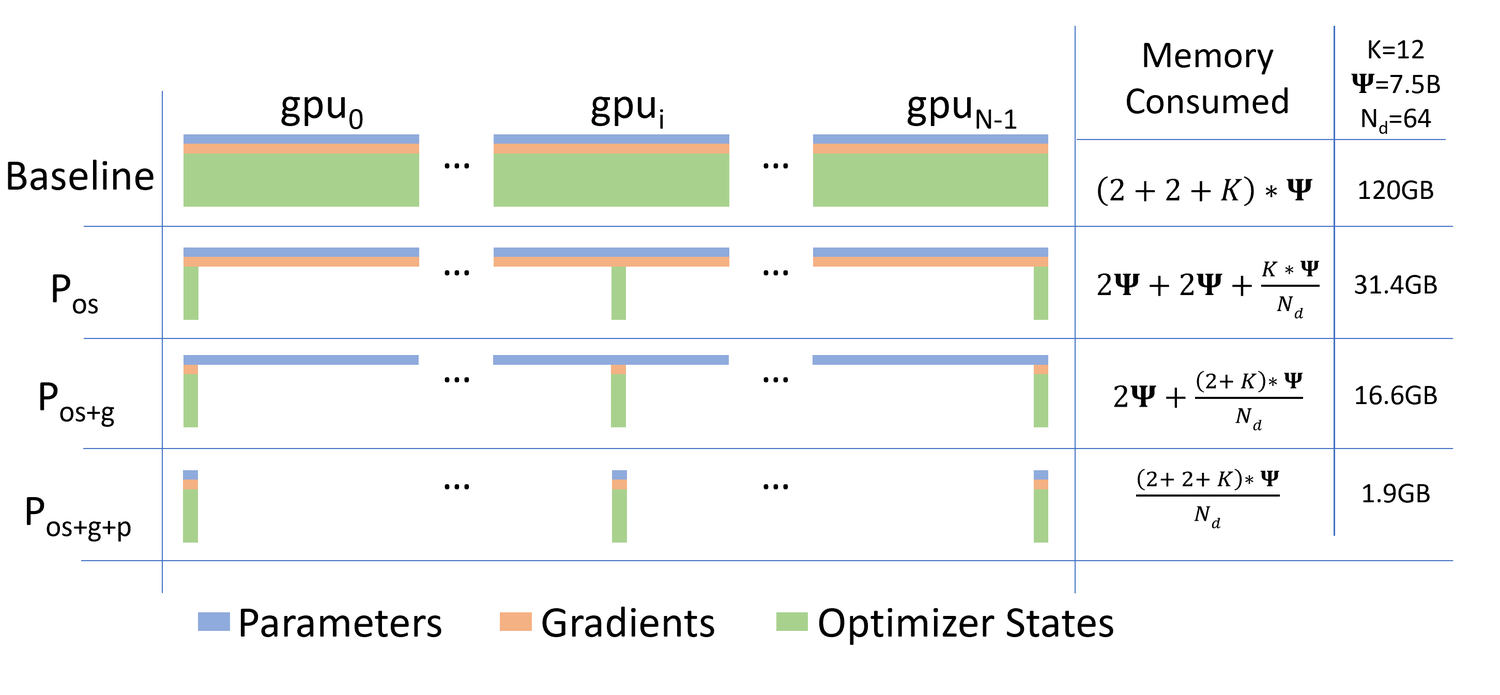
- Model states (parameters + gradients + optimizer states) dominate GPU memory: 16 bytes per parameter under mixed-precision Adam
- Traditional data parallelism replicates the entire training state on every GPU, wasting HBM
- ZeRO partitions training state across data-parallel GPUs in three cumulative stages (optimizer, gradients, parameters)
- ZeRO-3 reduces per-device model-state memory linearly with GPU count, at a 1.5x communication cost
ZeRO
DeepSpeed
Distributed Training
GPU Memory
Data Parallelism
Model Training
A100
Optimizer State Partitioning
Large Language Models