LATS: Language Agent Tree Search for Multistep Planning and Reasoning
ICML 2024
An engineering-first breakdown of Language Agent Tree Search (LATS): how MCTS, environment feedback, an LM value function, self-reflection, and memory wrap a frozen LLM into a self-improving planner — with runnable code in LangChain, DSPy, and LangGraph for AI-driven drug discovery.
- LATS wraps a pretrained LM with an inference-time search-and-feedback loop — no new model is trained and no weights are updated
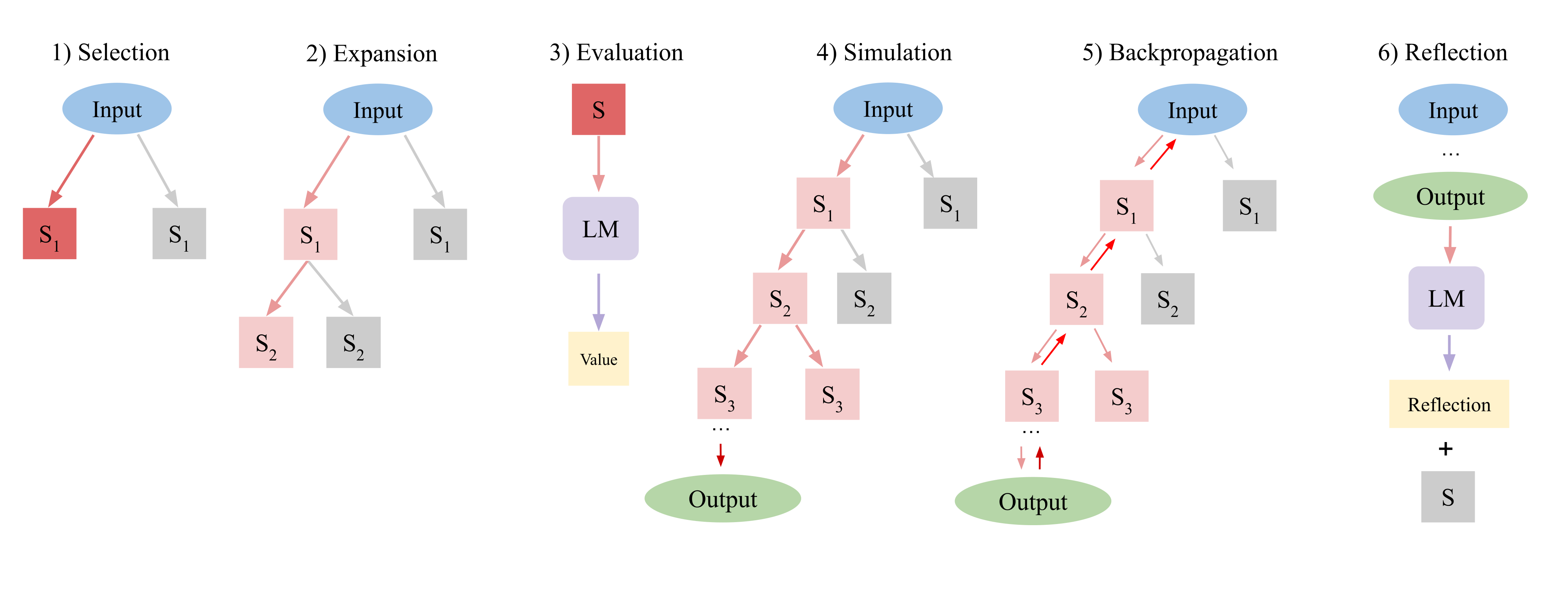
- Six operations — selection, expansion, evaluation, simulation, backpropagation, reflection — turn a single-shot agent into a planner over a tree of trajectories
- The value function V(s) = λ·LM(s) + (1−λ)·SC(s) reuses the LM as its own evaluator, avoiding a trained value network
- Self-reflection injects a semantic gradient — a written diagnosis of failure — that is far richer than a scalar reward and needs no gradient descent
- Full worked implementation for AI drug discovery: LangChain for the tool environment, DSPy for optimizable cognition, LangGraph for the MCTS control loop
Self-Improving Agents
Multistep Planning
Reasoning
Monte Carlo Tree Search
MCTS
In-Context Learning
Self-Reflection
Inference-Time Search
LATS
LangGraph
DSPy
LangChain
Drug Discovery
Agent Architecture