
This is a technical dissection of Llama-Nemotron — NVIDIA’s open family of efficient reasoning models. The family comes in three sizes — LN-Nano (8B), LN-Super (49B), and LN-Ultra (253B) — all derived from Llama 3, competitive with frontier reasoning models like DeepSeek-R1 while targeting superior inference throughput and memory efficiency.
The central claim is about how you get an efficient reasoning model cheaply: rather than training a new architecture from scratch, you take a strong Llama 3 model and search for an inference-optimized architecture (Puzzle NAS + FFN Fusion), recover any lost quality with distillation and continued pretraining, and only then layer on the reasoning-focused post-training (SFT + RL).
Attribution convention. Because this article mixes what the paper reports with my own reasoning, every non-obvious technical claim is tagged:
- [Paper] — stated explicitly in Llama-Nemotron (arXiv:2505.00949).
- [Derived] — a mathematical or logical consequence of the paper’s method, worked out here.
- [Interpretation] — my explanation or engineering reasoning, written for the reader; not a claim the paper makes.
Reasoning / Why I Studied This Paper
Most reasoning-model papers I’d read answered “how do we make a model reason better?” Llama-Nemotron asks a question I found more interesting: “how do we make a model reason better and run cheaply on the hardware we actually have?” That reframing is the reason I picked it apart.
The question I kept in my head throughout was simple: where does the efficiency come from, and what does it cost? A frontier reasoning model that fits on a single 8×H100 node and still beats DeepSeek-R1 sounds like a free lunch — so I wanted to find the bill. The answer turns out to be a sequence of moves, each recovering what the previous one gave up:
- Puzzle/NAS + FFN Fusion buy inference efficiency — but cost some quality.
- Distillation + continued pretraining recover that quality.
- SFT installs reasoning and the on/off toggle — but dents instruction-following.
- RL (reasoning, then preference) surpasses the teacher and repairs alignment.
So the mental model I read the paper through is a build pipeline, not a single trick: efficiency and capability are negotiated stage by stage rather than won in one shot. The other thread I traced is the dynamic reasoning toggle — a genuinely deployable idea (one model, two behaviours) that I wanted to understand precisely enough to separate what it is (a learned prompt-level switch) from what it is often mistaken for (an architecture change or a second model).
The rest of this dissection follows the paper’s five stages in order, with the benchmark tables at the end and my own commentary marked as [Interpretation] throughout.
I. Overview: A Family of Efficient Reasoning Models
Llama-Nemotron is introduced as an open family of heterogeneous reasoning models in three sizes, competitive with state-of-the-art reasoning models such as DeepSeek-R1 while offering superior inference throughput and memory efficiency. [Paper] This section unpacks that one-sentence claim at the abstract level: what “reasoning model” actually means here, how the reasoning behaviour is toggled, and which models were released and where to get them.
What a “Reasoning Model” Means Here
A reasoning model is one trained to think before it answers. Instead of mapping a prompt straight to a final answer in a single shot, it first spends inference-time compute producing an explicit, multi-step chain of thought — working through the intermediate steps of a math problem, a coding task, or a scientific question — and only then commits to a final answer. [Interpretation] The paper positions Llama-Nemotron squarely in this class, alongside DeepSeek-R1. [Paper]
The “efficient” half of the title is the other half of the claim: the family is designed to deliver that step-by-step reasoning while keeping inference throughput high and memory usage low. [Paper] The word “heterogeneous” points at how that efficiency is achieved — the architecture is allowed to vary from layer to layer (some layers drop attention, others shrink their FFN) rather than repeating one identical block, and that structure is searched for rather than hand-designed. I unpack the search itself in Section III. [Interpretation]
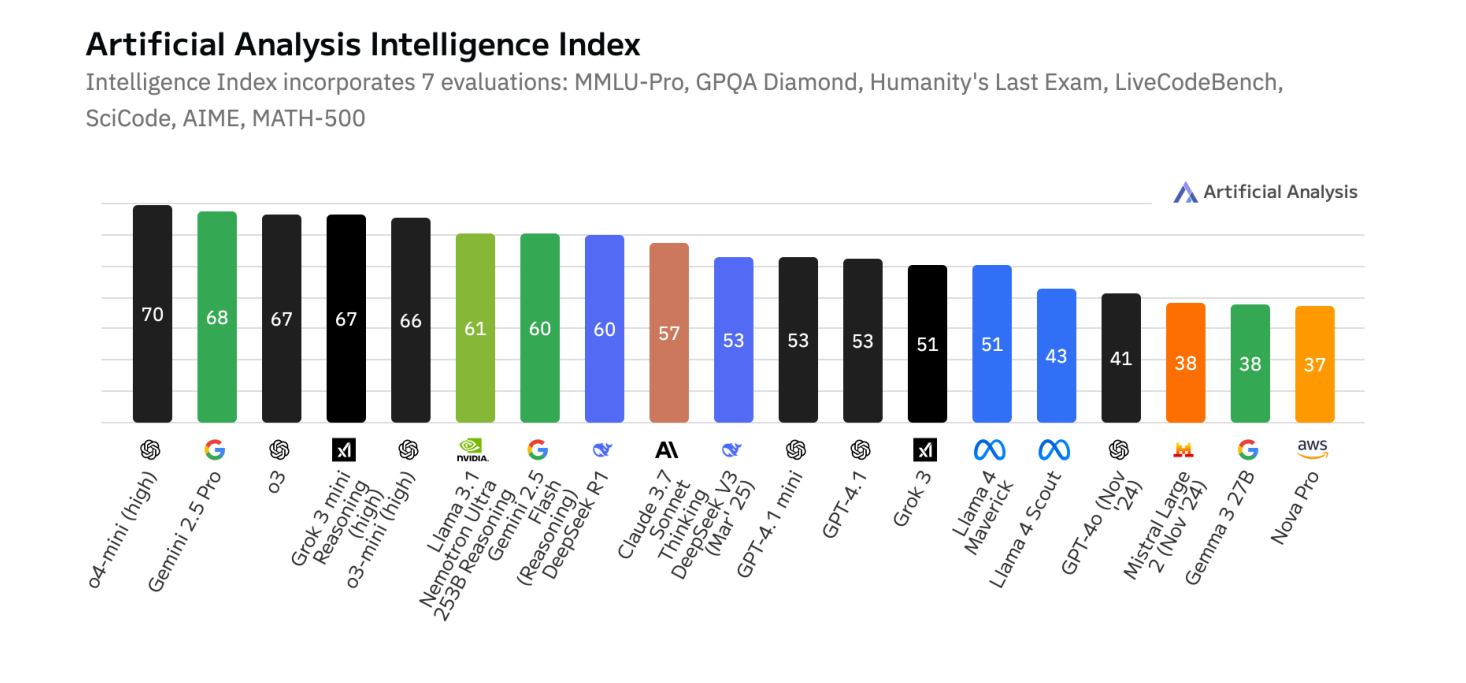
Figure 1 (from the paper). The claim I read off this chart: among fully open models, LN-Ultra sits at the top of the composite index, level with several closed frontier models. [Paper]
The Dynamic Reasoning Toggle: detailed thinking on / off
Llama-Nemotron models are the first open-source models to support a dynamic reasoning toggle: the same model can behave either as a step-by-step reasoner or as a standard chat assistant, and you choose which at inference time. [Paper]
The switch is a lightweight system prompt: [Paper]
detailed thinking on→ the model produces its reasoning (a chain of thought) before answering.detailed thinking off→ the model answers directly, in normal chat style.
Crucially, this is a learned behaviour, not a runtime architecture change. During training the model is shown paired examples — the same prompt with a reasoning response (conditioned on detailed thinking on) and with a plain response (conditioned on detailed thinking off) — so it learns to associate each instruction with the corresponding output style. [Paper]
Two things the toggle is explicitly not: [Interpretation]
- It does not swap the architecture or load a second model. There is one set of weights; only the conditioning prompt changes — the paper stresses this gives both general-purpose chat and detailed reasoning without requiring separate models or architectures. [Paper]
- It is a switch between requests, not something you flip mid-generation. You set the system prompt for a conversation; you don’t change the mode partway through a single running answer. [Interpretation]
The data curation that makes this simple instruction meaningful — the paired reasoning / non-reasoning dataset — is covered in Section V.
The Model Family, Sizes, and Availability
Three model sizes, all derived from Llama 3 and released under the commercially permissive NVIDIA Open Model License Agreement, plus a fourth continued-pretraining checkpoint. All are on Hugging Face under the nvidia organization. [Paper]
| Model (Hugging Face) | Params | Base / Notes |
|---|---|---|
| Llama-3.1-Nemotron-Nano-8B-v1 (LN-Nano) | 8B | from Llama 3.1 |
| Llama-3.3-Nemotron-Super-49B-v1 (LN-Super) | 49B | from Llama 3.3 |
| Llama-3.1-Nemotron-Ultra-253B-v1 (LN-Ultra) | 253B | from Llama 3.1 |
| Llama-3.1-Nemotron-Ultra-253B-CPT-v1 | 253B | continued-pretraining checkpoint of Ultra, before the reasoning SFT + RL |
The complete post-training data is also released as the Llama-Nemotron-Post-Training-Dataset, and the training codebases (NeMo, NeMo-Aligner, Megatron-LM) are open-sourced. [Paper]
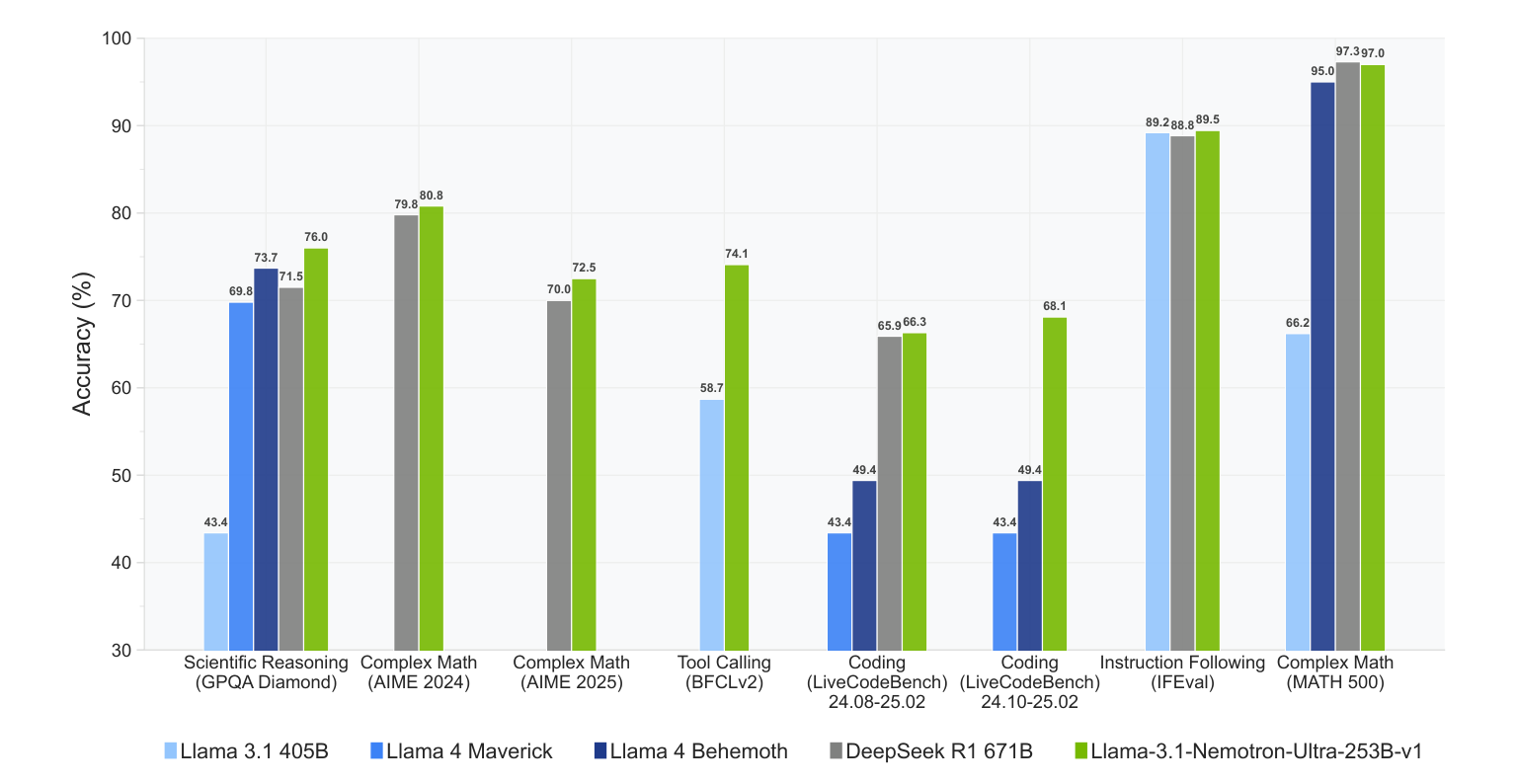
Figure 2 (from the paper). The abstract-level read: LN-Ultra (green) is at or near the top across this spread of reasoning and non-reasoning benchmarks, holding its own against DeepSeek-R1 (a much larger 671B model). [Paper]
How the Models Are Built: Five Stages
The paper frames the whole construction as a five-stage pipeline, and the rest of this dissection follows it stage by stage: [Paper]
- Architecture optimization (NAS + FFN Fusion). Start from a Llama 3 model, search for an inference-efficient architecture, then fuse consecutive FFN blocks to cut sequential depth. (Section III)
- Recovery training. Knowledge distillation plus continued pretraining, to restore the quality lost during the architectural surgery. (Section IV)
- Supervised fine-tuning. SFT on a mix of standard instruction data and reasoning traces from strong teachers such as DeepSeek-R1 — this is what teaches the model to reason in multiple steps. (Section VI)
- Large-scale reinforcement learning. RL on complex mathematics and STEM data — the step that lets the student surpass its teacher. For LN-Ultra it drives a substantial GPQA-Diamond gain, and it is made feasible by a custom training framework whose headline optimization is generation in FP8. (Section VII)
- Alignment. A short final stage focused on instruction following and human preference. (Section VIII)
Stages 3–4 run on the open-sourced Llama-Nemotron-Post-Training-Dataset — synthetic responses from a range of open-source models, targeting mathematical reasoning, coding, science, and instruction following, then filtered for quality, correctness, and complexity to give strong training signals. [Paper] (Section V)
II. The Problem: Efficient Reasoning at Inference Time
A defining characteristic of modern reasoning models is that their answers are long. A single response often carries an extended chain of thought — the model working the problem out, self-verifying, reflecting, and even backtracking when a line of reasoning fails. [Paper] That verbosity is not a defect; it is how these models reach state-of-the-art results on the hardest tasks, from PhD-level STEM questions to competition-level mathematics. [Paper]
But long responses have a cost: they push more and more compute to inference time. Here is the shift the paper leans on — as capability increasingly comes from scaling test-time compute, inference efficiency stops being a mere deployment concern and becomes a core limiting factor on model intelligence itself, and on the viability of agentic pipelines that chain many model calls together. [Paper] So for Llama-Nemotron, maximizing inference efficiency is a primary optimization objective, not an afterthought. [Interpretation]
This is also why the reasoning toggle exists. Not every query benefits from detailed multi-step reasoning — for a simple lookup a long chain of thought is wasteful and can even be counterproductive. Letting the user turn reasoning on or off ensures inference compute is spent only where it earns its keep, and that the response style stays appropriate to the task. [Paper]
The efficiency target is concrete: LN-Ultra outperforms DeepSeek-R1 while fitting on a single 8×H100 node, with higher inference throughput, and the models support a 128K-token context length. [Paper] The next section is how that efficient architecture is obtained.
III. Creating Inference-Optimized Models: Puzzle NAS + FFN Fusion
The first stage answers the efficiency problem with two complementary optimizations: NAS chooses a better architecture, and FFN Fusion reduces the sequential depth of that architecture. [Interpretation]
NAS from Llama 3: The Puzzle Framework
Rather than train a new architecture from scratch — or naively shrink every layer of a Llama 3 model by the same amount — Puzzle searches for a good architecture. The parent is a Llama 3 Instruct model: Llama-3.3-70B-Instruct for LN-Super and Llama-3.1-405B-Instruct for LN-Ultra. [Paper] It works in two moves. [Paper]
Move 1 — build a block library (the “puzzle pieces”). For each transformer block in the parent, Puzzle creates several alternative blocks and trains each one independently and in parallel with block-wise local distillation — the alternative is optimized to approximate the function of its parent block while improving a computational property (latency, memory, throughput). [Paper] Every candidate therefore carries an explicit accuracy–efficiency trade-off profile: cheaper blocks may cost some quality. [Paper] The variants include: [Paper]
- Attention removal — the block omits the attention mechanism entirely, cutting both compute and KV-cache memory.
- Variable FFN dimensions — the FFN’s intermediate size is compressed at different granularities (e.g. 87%, 75%, 50%, down to 10% of the original).
- Plus additional operations Puzzle supports — grouped-query attention (GQA) with different numbers of KV heads, linear attention alternatives, and no-op substitutions — though empirically, attention removal and FFN compression proved the most effective for LN-Super and LN-Ultra’s throughput and memory savings. [Paper]
Move 2 — assemble with MIP. A mixed-integer programming solver then selects exactly one block per layer, choosing the most efficient configuration under a set of constraints — hardware compatibility, maximum latency, memory budget, desired throughput. [Paper] Because each layer offers variants at different trade-off profiles, Puzzle can target any point on the accuracy–efficiency Pareto frontier — including constraints set by agentic systems or deployment pipelines, such as bounded memory use or a tight end-to-end response time. [Paper]
The result is a heterogeneous model: different layers keep different blocks — some drop attention, others retain it but with a smaller FFN — because not every layer needs to do the same amount or type of computation. [Interpretation] These two moves are exactly what the figure below labels crafting the puzzle pieces (Step 1) and assembling the puzzle architecture (Step 2).
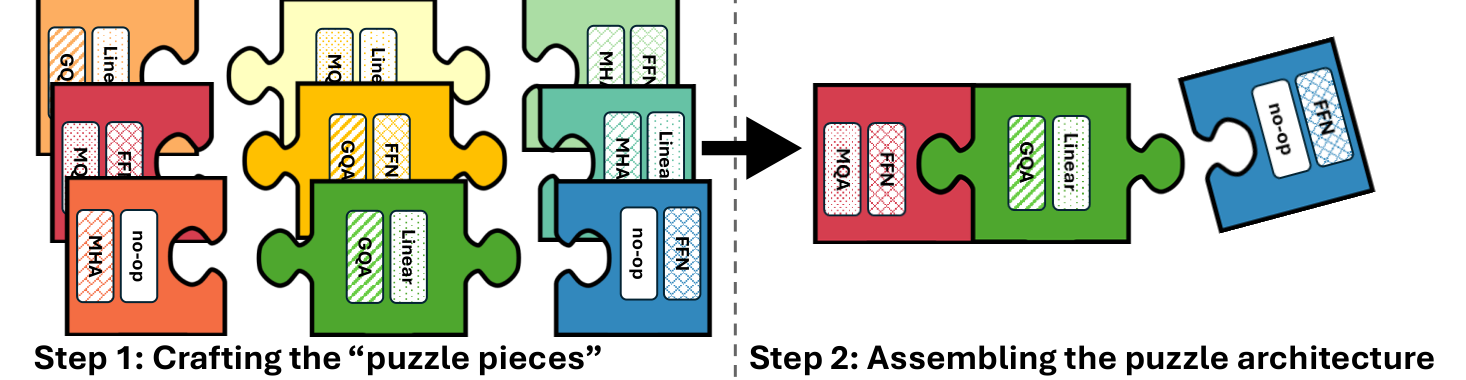
Figure 3 (from the paper). Step 1 builds and scores alternative blocks in parallel; Step 2 uses MIP to select one block per layer under the target hardware constraints. [Paper]
FFN Fusion: Collapsing Sequential Depth
Once Puzzle removes attention from some blocks, the model is left with runs of consecutive FFN blocks. [Paper] Executed normally, those FFNs still run one after another — each is a separate sequential step for the GPU, even if it is individually fast. [Interpretation]
FFN Fusion rewrites such a run into fewer, wider FFN layers that execute in parallel, cutting the number of sequential steps without sacrificing expressivity. [Paper] This matters most in multi-GPU serving, where shortening the sequential path also reduces the inter-layer communication overhead. [Paper]
So the two optimizations answer different questions: [Interpretation]
- Puzzle / NAS: which block should each layer use for the best quality/efficiency trade-off?
- FFN Fusion: now that attention has been thinned out, which consecutive FFNs can be merged to shorten the critical path?
Deployment Constraints and Efficiency Targets
Puzzle searches against concrete hardware budgets, and the two large models target different deployments: [Paper]
- LN-Super targets a single H100 GPU at tensor-parallelism 1 (TP1). Puzzle yields a 5× throughput speedup over Llama-3.3-70B-Instruct at batch size 256 (TP1); and even against Llama-3.3-70B-Instruct running at its best config (TP4), LN-Super at TP1 still delivers a ≥2.17× throughput advantage. It is optimized under a budget of roughly 300K cached tokens (batch × sequence) at FP8 on one H100 — e.g. batch size 16 × sequence length 18,750. [Paper]
- LN-Ultra targets a full 8×H100 node. During Puzzle’s search it is constrained to at least a 1.5× latency reduction over Llama-3.1-405B-Instruct; after applying FFN Fusion, the final model reaches a 1.71× latency improvement. It supports up to 3M cached tokens at FP8 (600K at BF16) on an H100 node. [Paper]
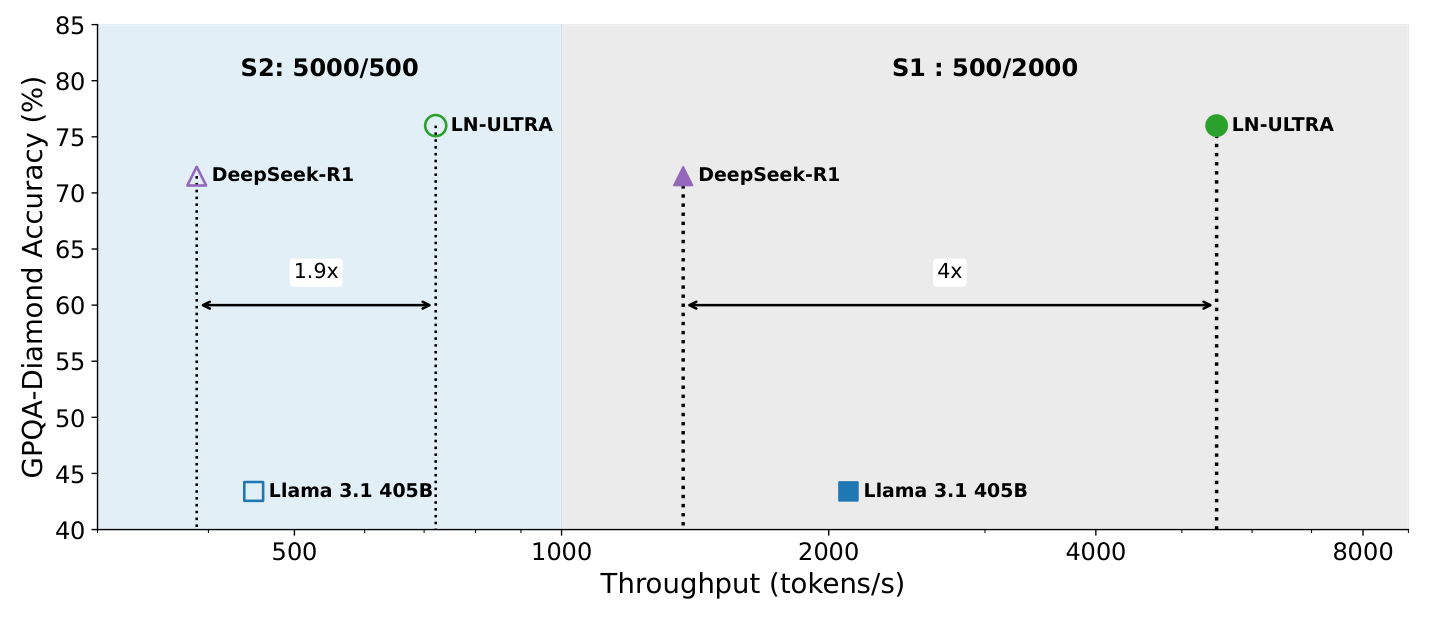
Figure 4 (from the paper). The payoff plot: LN-Ultra (green) matches or beats DeepSeek-R1 on GPQA-Diamond accuracy while running 1.9×–4× faster, so it dominates on the accuracy–throughput Pareto curve rather than trading one for the other. [Paper]
IV. Post-NAS Training: Knowledge Distillation & Continued Pretraining
Swapping blocks in and out leaves the layers slightly mismatched and costs some quality, so after the search both large models get recovery training to restore inter-block compatibility and claw back the lost quality. [Paper]
- LN-Super — knowledge distillation for 40B tokens over the Distillation Mix dataset. [Paper]
- LN-Ultra — knowledge distillation for 65B tokens on the same dataset, then 88B tokens of continued pretraining on the Nemotron-H phase-4 pretraining dataset. [Paper]
That short distillation-plus-pretraining is enough for LN-Ultra to match and even surpass its reference model, Llama-3.1-405B-Instruct — evidence that aggressive architecture surgery can be reconciled with frontier quality. [Paper] The comparison below is measured before any reasoning SFT or RL — i.e. the released Llama-3.1-Nemotron-Ultra-253B-CPT checkpoint:
| Task | LN-Ultra CPT | Llama-3.3-70B-Instruct | Llama-3.1-405B-Instruct |
|---|---|---|---|
| MMLU | 88.1 | 81.4 | 88.6 |
| MATH500 | 80.4 | 73.6 | 69.6 |
| HumanEval | 88.4 | 84.1 | 86.0 |
| RULER 128K | 83.2 | 52.2 | 73.7 |
Table 1 (from the paper). LN-Ultra after continued pretraining, before SFT/RL. It already leads on MATH500, HumanEval, and long-context RULER-128K, and is level with the 405B on MMLU — at a fraction of the inference cost. [Paper]
V. Synthetic Data & the Reasoning Toggle
Both reasoning and non-reasoning data are curated for supervised fine-tuning. Reasoning samples carry the system instruction detailed thinking on; non-reasoning samples carry detailed thinking off. Training on both, each conditioned on its instruction, is exactly what teaches the model to toggle reasoning behaviour at inference time (Section I). [Paper] The reasoning-on data is curated per domain; the shape of each pipeline is collect problems → generate solutions with a strong teacher → filter hard for correctness. [Interpretation]
Reasoning-On Data: Math
The math pipeline follows Moshkov et al. (2025). Problems are collected from Art of Problem Solving (AoPS) community forums (all discussions except “Middle School Math,” which was too easy to help). Qwen2.5-32B-Instruct runs most steps: [Paper]
- Problem extraction — an LLM pulls the problem(s) out of each forum post.
- Problem classification — each problem is tagged (proof? multiple-choice? binary yes/no? valid?); proof, multiple-choice, binary, and invalid problems are dropped.
- Answer extraction — only the final answer is extracted (not full solutions), so correctness can be checked automatically.
- Benchmark decontamination — an LLM-based comparison removes problems that closely resemble popular math benchmarks.
- Solution generation — DeepSeek-R1 produces reasoning solutions (16 generations/problem) and Qwen2.5-Math-7B-Instruct produces non-reasoning solutions (64 generations/problem).
- Solution filtering — solutions that don’t reach the expected answer are discarded, with Qwen2.5-32B-Instruct judging answer equivalence; where no answer can be extracted, the most common answer across candidates is taken as ground truth.
Prompts and scripts are released in NeMo-Skills. [Paper]
Reasoning-On Data: Code
The code pipeline (Ahmad et al., 2025) is collect → generate → post-process: [Paper]
- Question collection & verification — 28,904 unique competitive-programming questions aggregated from TACO, APPS, CodeContests, and CodeForces, after exact-match dedup; contamination against benchmarks is checked with cosine-similarity plus LLM judges (Llama-3.3-70B, Qwen2.5-32B), with manual verification confirming < 0.3% overlap.
- Solution generation — DeepSeek-R1 generates multiple solutions per question, mostly Python (C++ for some benchmarks), via nucleus sampling (temperature 0.6, top-p 0.95) in SGLang, explicitly prompting for reasoning inside
<think>tags. - Post-processing — verify the reasoning trace is present, extract the code segment, drop samples with code inside the reasoning tags, and validate syntax with Tree-sitter → about 488K Python samples.
Data-scaling insight: unlike math, where small datasets can suffice to induce reasoning, coding needs large-scale data — an ablation from 25k → 736k samples improves continuously (no plateau), and front-loading generation on harder CodeContests problems before expanding gives the biggest gains. [Paper]
Reasoning-On Data: Science
Open-ended questions and MCQs are curated from in-house and external sources — StackOverflow Q&A pairs plus synthetic MCQs: [Paper]
- Synthetic question generation — academic topics/subtopics (physics, biology, chemistry, …) are defined with Nemotron-4-340B-Instruct; Qwen2.5 then generates MCQs conditioned on topic, subtopic, and difficulty level, each format-checked, and augmented with question variations (OpenMathInstruct-2 pipeline).
- Benchmark decontamination — the whole set (real + synthetic) is decontaminated against GPQA, MMLU, and MMLU-Pro.
- Solution generation — DeepSeek-R1 produces multiple reasoning traces; for questions without ground truth, majority voting infers the most likely correct answer.
Reasoning-Off Data: Teaching the “Off” Switch
The toggle only means something if the model has seen the same kind of prompt answered both ways. So the reasoning-off data is built as a pairing exercise: prompts are randomly sampled from the reasoning dataset above, and a non-reasoning response is generated for each — using Llama-3.1-Nemotron-70B-Instruct for general-domain prompts and Llama-3.3-70B-Instruct for the rest. Each response is then tagged with the matching system instruction — detailed thinking on for the reasoning version, detailed thinking off for the plain one. Seeing both, prompt-for-prompt, is what teaches the model to modulate its reasoning on the system prompt rather than always reasoning or never reasoning. [Paper]
These responses are filtered against ground-truth answers or reward models, and the mix is broadened with permissively licensed function-calling and safety data (augmented in-house) to shore up those capabilities. [Paper]
General-Domain Responses: A Feedback-Edit Loop
For open-ended general prompts there is no ground-truth answer to filter against, so quality is manufactured instead. The paper uses a Feedback-Edit inference-time-scaling system (Wang et al., 2025b): starting from 20K first-turn prompts drawn from ShareGPT and WildChat-1M, Llama-3.1-Nemotron-70B-Instruct generates several candidate responses per prompt, which are then refined through three specialized models — a Feedback model flags what to improve, an Edit model applies those targeted fixes, and a Select model picks the best edited response. The output is a 20K-prompt set of high-quality general-domain responses. [Paper]
The reason this is inference-time scaling: extra compute is spent at generation time (multiple drafts, then feedback → edit → select) to raise the quality of the training data — a distinct axis from spending compute at training time. [Interpretation]
My Take: An Instructional SFT Curriculum
My own extension — this is not what the paper does. I keep it clearly separate from NVIDIA’s method here.
Reading the math pipeline, one thing stands out: SFT here is a correctness filter, not an instructional one. The teacher (DeepSeek-R1) generates a solution and it is kept only if its final answer matches the expected one — the training signal is “this trajectory happened to be right,” not “here is the procedure you should follow.” [Interpretation]
If it were my pipeline, I’d make the SFT data more explicitly instructional in two ways: [Interpretation]
- Procedure-first examples — pair each problem with a known answer and a clean step-by-step derivation (
problem → reasoning procedure → correct answer), so the model learns the method, not just answer-matching. - Error-correction examples — show a wrong attempt, then teach the model to locate the faulty step and repair it (
wrong reasoning → identify error → correct reasoning → correct answer), making error recognition a directly supervised behaviour.
The important distinction is against the paper’s RL stage (Section VII): RL is where the model generates its own attempts and is rewarded for correct answers — the paper even discards problems LN-Super already solves with pass rate ≥ 0.75, pushing RL toward what the model can’t yet do. [Paper] That is how the student explores beyond the teacher, whereas SFT/distillation can only approach it. [Paper] So my instructional curriculum is an idea for the SFT side; it does not describe NVIDIA’s method, which for math explicitly filters out solutions that miss the expected answer rather than feeding wrong answers on purpose. [Interpretation]
VI. Supervised Fine-Tuning
If NAS and continued pretraining gave the models an efficient body and broad knowledge, SFT is where the reasoning behaviour is actually installed. It does two jobs at once: it distills reasoning from strong teachers such as DeepSeek-R1 by training on their reasoning traces (Section V), and it establishes fine-grained style control through the detailed thinking on / off instruction. [Paper] The paper’s own finding echoes recent work: training on large-scale, high-quality reasoning traces is what elicits robust reasoning downstream. [Paper]
General Methodology
All models are trained with a token-level cross-entropy loss over the instruction-tuning data, and training batches mix reasoning and non-reasoning data — each prompt paired with a response conditioned on the matching detailed thinking on/off instruction. [Paper] A few empirical lessons the paper calls out: [Paper]
- Higher learning rates are needed to learn effectively from long reasoning traces — partly a consequence of sequence-length-dependent token-loss averaging.
- Extended training over multiple epochs helps, especially for smaller models.
- The Adam optimizer with a cosine learning-rate decay and a linear warmup (~10% of total steps) was important for stability — crucial for LN-Ultra in particular.
Model-Specific Training
Each size was trained differently, and the differences are instructive: [Paper]
- LN-Nano — a three-stage SFT pipeline (global batch 256, sequence packing at 32K effective length). Stage 1: reasoning data only (code, math, science) at LR 1e−4 for four epochs — training on reasoning alone first prevents failure modes like repetitive completions. Stage 2: mix in non-reasoning data so the model learns reasoning control (the toggle). Stage 3: a smaller blend focused on chat, instruction-following, and tool-calling.
- LN-Super — the full SFT dataset for a single epoch (fixed LR 5e−6, sequence length 16K, batch 256). Smaller runs hinted that 3–4 epochs at a larger LR (5e−5) would do better, but compute and time capped it. Rejection fine-tuning was tried and dropped — it gave no gains here.
- LN-Ultra — the full dataset with sequence packing at 24K effective length (batch 256) to maximize token throughput. Higher LRs (5e−5) helped in ablations but caused gradient explosions; the fix was a linear warmup to 1e−5 then cosine decay to 1e−6 (10% warmup ratio). Even so, training hit gradient explosions and numerical instability after the first epoch, and only converged after resuming with reinitialized optimizer states. [Paper]
The recurring theme: the larger the model and the longer the reasoning traces, the more fragile the optimization — long-context reasoning SFT is as much a stability problem as a data problem. [Interpretation]
VII. Reinforcement Learning for Reasoning
Here is the ceiling problem stated plainly: distillation can only take the student up to the teacher, never past it. SFT lets LN-Ultra approach DeepSeek-R1 but not exceed it — and when the student’s base is stronger than the teacher’s, that ceiling is a real limitation. To let the model surpass its teacher, it has to explore and self-improve, and that is what large-scale RL provides. [Paper] Consistent with DeepSeek-R1’s findings, RL underperformed distillation for the smaller models, so — given that plus resource constraints — the paper applies reasoning RL only to LN-Ultra, which is what pushes it to a state-of-the-art GPQA result among open models. [Paper]
The RL Pipeline: GRPO on Scientific Reasoning
The algorithm is Group Relative Policy Optimization (GRPO). The loop, for LN-Ultra: [Paper]
- Take a rollout batch (prompt size 72) and sample 16 responses per prompt (temperature 1, top-p 1).
- Score each response with two rewards (below).
- Update the policy (global batch 576, 2 gradient updates per rollout), repeating until convergence on reasoning tasks.
The two reward signals are: [Paper]
- Accuracy reward — every training example has a ground-truth answer (a number, a sentence, or a paragraph); a served Llama-3.3-70B-Instruct judges whether the policy’s prediction matches it.
- Format reward — following DeepSeek-R1, this enforces that the model wraps its thinking in
<think>…</think>underdetailed thinking on, and that those tags are absent underdetailed thinking off. So RL reinforces the toggle as well as correctness.
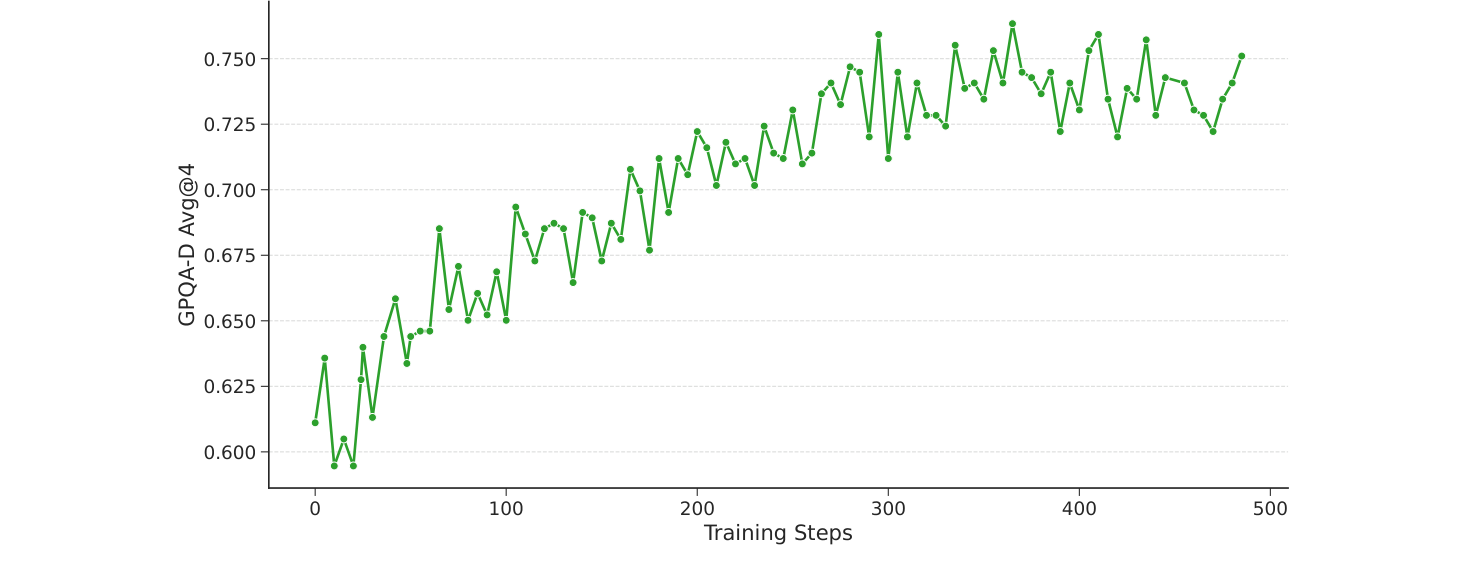
Figure 5 (from the paper). Reasoning RL moves LN-Ultra’s GPQA-Diamond accuracy from ~0.61 to ~0.75 across training — the concrete evidence of the student surpassing its distillation ceiling. [Paper]
Difficulty Filtering and Curriculum
RL only teaches something when the problems are actually hard for the current model, so the paper shapes the data twice: [Paper]
- Difficulty filtering. For each question, LN-Super generates 8 responses; the pass rate is computed; prompts with pass rate ≥ 0.75 (already easy) are intentionally discarded, concentrating training on what the model can’t yet reliably solve.
- Curriculum training. A progressive-batching strategy uses the pre-computed pass rate as a difficulty metric. A Gaussian target distribution over pass rates is centred on a difficulty that shifts from easy to hard across successive batches; samples are allocated to batches to match that target (remaining capacity filled from the largest available pass-rate pools), while samples within a batch are shuffled. The net effect is a controlled, gradual increase in difficulty over training.
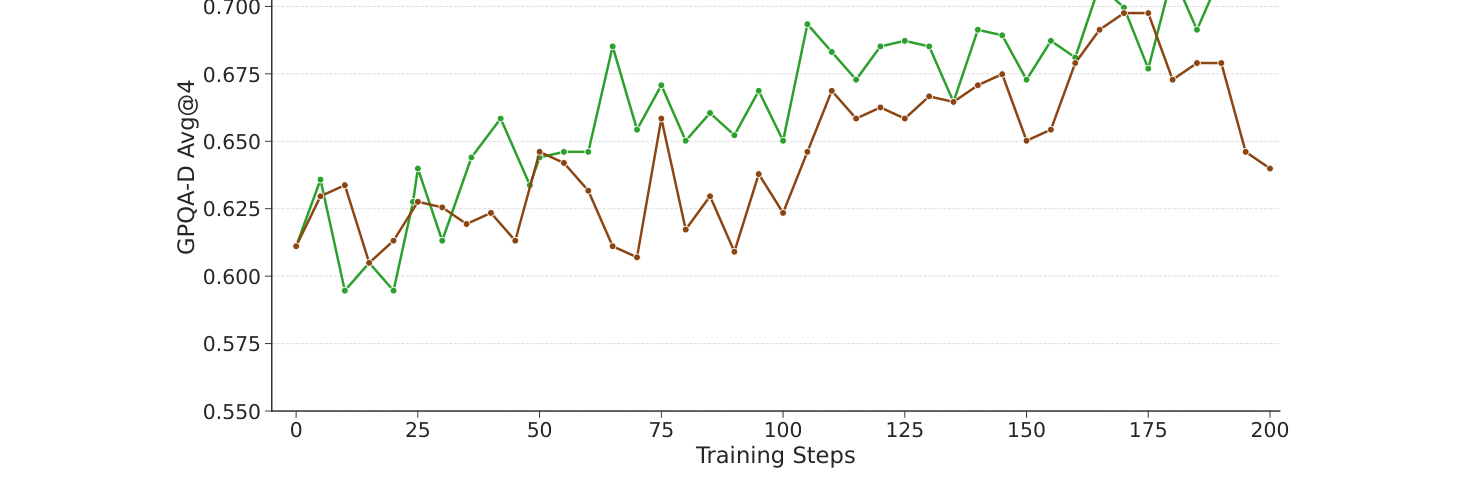
Figure 6 (from the paper). Curriculum ordering (green) both stabilizes training and lands higher than random ordering (brown) — difficulty scheduling is doing real work, not just cosmetics. [Paper]
Infrastructure: FP8 Generation, BF16 Training
The reason RL of a 253B model is even tractable is an infrastructure choice, and it’s worth stating precisely so the two things aren’t conflated: GRPO is the RL algorithm; the FP8 optimization lives in the generation stage. [Interpretation] The setup: [Paper]
- NeMo-Aligner (a dev branch adding GRPO + heterogeneous-model support) drives RL; generation runs on vLLM, training on Megatron-LM, and the two stages are co-located on the same GPUs — weights are synced each step (all-gathered, converted to vLLM format via shared memory), with each stage sleeping/offloading to free memory for the other.
- Precision: generation is done in FP8, training in BF16 with FP32 optimizer states. Because generation (rollouts) dominates the RL step, making generation cheap is what buys the throughput. [Paper]
- Scale: 72 nodes × 8×H100; the full run is ≈140K H100-hours. [Paper]
So the clean mental model of this stage is: SFT/distillation → Scientific-Reasoning RL (GRPO; generation in FP8, training in BF16) → preference optimization. The FP8 half is generation-side infrastructure, not part of GRPO’s objective. [Interpretation]
VIII. RL for Preference Optimization
This is a separate, later stage from the scientific-reasoning RL — easy to blur together, but the objective is different. Section VII made the model reason better; this stage makes it follow instructions and behave as a helpful chat assistant while carefully preserving everything gained earlier. [Paper]
Instruction Following
After reasoning RL, LN-Super and LN-Ultra get a short RL run for instruction following. Using a verification setup like Zhou et al. (2023), synthetic prompts carrying one to ten detailed instructions are generated, and RL is run with the RLOO algorithm for fewer than 120 steps (batch 128), rewarded by an instruction-following verifier. Notably, this lifts scores on both instruction-following and reasoning benchmarks. [Paper]
RLHF for Helpfulness and Chat
The final alignment step targets general helpfulness and chat without eroding the model’s other skills — and the per-model recipe differs: [Paper]
- LN-Super — iterative online RPO, maximizing the reward of Llama-3.1-Nemotron-70B-Reward over HelpSteer2 prompts (LR 4e−7, KL β 1e−5, reward scale 3.0, batch 64, 500 steps). Two iterations push its Arena Hard score from 69.1 → 88.1, and — strikingly — improve every other benchmark except IFEval, even though neither the data nor the reward model targets math/code/science. The paper’s read: RLHF helps the model better use knowledge it already has. At 49B, LN-Super’s 88.3 Arena Hard beats far larger and proprietary models. [Paper]
- LN-Ultra — the same process but with GRPO: 8 responses per prompt, 30 steps, LR 3e−7, batch 288, KL β 1e−3. [Paper]
- LN-Nano — two rounds of offline RPO on on-policy data: round one mixes reasoning and non-reasoning data (with the right system prompts) to sharpen reasoning control; round two uses on-policy generations to improve instruction following (each round ≤400 steps, LR 7e−7, KL β 3e−2, batch 512). [Paper]
The takeaway across both RL stages: reasoning RL and preference RL are complementary, not the same knob — one raises the reasoning ceiling, the other aligns behaviour, and each uses whichever algorithm (GRPO / RPO / RLOO) suited that model and objective. [Interpretation]
IX. Evaluations & Results
Models are evaluated in both modes — detailed thinking on and off — across reasoning benchmarks (AIME 2024/2025, GPQA-Diamond, LiveCodeBench, MATH500) and non-reasoning ones (IFEval, BFCL V2 Live tool-calling, Arena-Hard), all at 32K context, reporting average pass@1. [Paper] The on | off split below is the point of the whole design: one model, two behaviours.
LN-Ultra: Surpassing the Teacher
LN-Ultra is state-of-the-art on GPQA among open models, and the SFT→RL story is visible in the numbers — SFT alone (LN-Ultra-SFT) approaches DeepSeek-R1, but RL is what pushes GPQA past it. It does this while running on a single 8×H100 node (DeepSeek-R1 needs 8×H200). [Paper]
| Task | LN-Ultra (on | off) | DeepSeek-R1 | Llama-3.1-405B-Instruct |
|---|---|---|---|
| GPQA-Diamond | 76.0 | 56.6 | 71.5 | 43.4 |
| AIME24 | 80.8 | 20.0 | 79.8 | 20.0 |
| AIME25 | 72.5 | 16.7 | 70.0 | 0.0 |
| MATH500 | 97.0 | 80.4 | 97.3 | 66.2 |
| LiveCodeBench (2408–2502) | 66.3 | 29.0 | 65.9 | – |
| IFEval | 88.9 | 89.5 | 88.8 | 89.2 |
| Arena Hard | 87.0 | 92.0 | 66.2 |
Table 5 (from the paper, condensed). LN-Ultra reasoning-on leads on GPQA-D and AIME; MATH500 and Arena-Hard stay close to DeepSeek-R1 at a fraction of the serving cost. [Paper]
LN-Super: Both Modes in One 49B Model
LN-Super is competitive in its weight class: reasoning-off it roughly matches its Llama-3.3-70B base; reasoning-on it beats DeepSeek-R1-Distilled-Llama-70B — one model covering both use cases. Its 49B Arena-Hard 88.3 beats much larger and proprietary models; the dedicated IFEval RL run (Section VIII) exists specifically to repair the instruction-following drop that reasoning SFT introduced. [Paper]
| Task | LN-Super (on | off) | R1-Distill-Llama-70B | QwQ-32B | Llama-3.3-70B |
|---|---|---|---|---|
| GPQA-Diamond | 66.7 | 50.0 | 65.2 | 58.8 | 50.5 |
| AIME24 | 67.5 | 16.7 | 70.0 | 79.5 | 25.8 |
| AIME25 | 60.0 | 16.7 | 55.0 | 65.8 | 6.7 |
| MATH500 | 96.6 | 74.0 | 94.5 | 96.2 | 73.8 |
| LiveCodeBench (2408–2502) | 45.5 | 29.7 | 57.5 | 63.4 | – |
| IFEval | 89.2 | 89.0 | 85.1 | 86.3 | 92.1 |
| Arena Hard | 88.3 | 65.4 | 90.5 | 72.9 |
Table 4 (from the paper, condensed). The LiveCodeBench gap is a known artifact — LN-Super’s SFT used an earlier code dataset than Nano/Ultra. [Paper]
Out-of-Distribution: LLM-as-a-Judge
On JudgeBench (a task they weren’t trained for), LN-Ultra is the best open model, beating DeepSeek-R1 and trailing only o3-mini(high); LN-Super beats o1-mini — evidence the reasoning generalizes beyond the training tasks. [Paper]
| Model | Overall (JudgeBench) |
|---|---|
| o3-mini(high) | 80.86 |
| LN-Ultra | 79.14 |
| DeepSeek-R1 | 73.14 |
| LN-Super | 69.71 |
| o1-mini | 65.71 |
Table 6 (from the paper, condensed). [Paper]
The single most important read across all three tables: SFT builds the reasoning floor, RL raises the ceiling, and a multi-stage post-training pipeline is what makes one model good everywhere at once. [Paper]
X. Key Takeaways
- Efficiency is treated as a first-class objective, not a deployment afterthought. Because capability increasingly comes from test-time compute, inference efficiency becomes a limit on intelligence itself — so the architecture is searched for, not just trained. [Paper]
- One model, two behaviours. The
detailed thinking on/offtoggle is a learned, prompt-level switch trained from paired data — no second model, no architecture change, no mid-generation flipping. [Paper] - SFT sets the floor; RL raises the ceiling. Distillation can only approach the teacher; large-scale, curriculum-driven, verifiable-reward RL (GRPO, generation in FP8) is what lets LN-Ultra surpass DeepSeek-R1 on GPQA. [Paper]
- A great all-rounder needs the whole pipeline. No single stage produces a model strong across reasoning and chat and tool use — the multi-stage post-training is the point. [Paper]
The Whole Story in One Line
As a mental model, the paper is:
Llama 3
   ↓
Puzzle / NAS  →  inference-optimized heterogeneous architecture
   ↓
Knowledge Distillation + Continued Pretraining   (recover quality)
   ↓
SFT   (install reasoning + the on/off toggle)
   ↓
Reasoning RL   (GRPO for LN-Ultra — surpass the teacher)
   ↓
Preference Optimization / RLHF   (align: helpfulness, chat, IF)
   ↓
Llama-Nemotron
The shorthand “Llama 3 → Puzzle → SFT → RLHF → Nemotron” is fine for recall, but it hides two things worth keeping straight: the recovery training (distillation + continued pretraining) after the search, and the fact that there are two distinct RL stages — reasoning RL, then preference optimization. And a small but important correction: Puzzle isn’t the model — it’s the NAS framework that turns the Llama architecture into an inference-optimized one. [Interpretation]
The Core Idea Behind Puzzle/NAS
The conceptual shift is what makes this whole family possible. Traditional NAS asks:
“Find the most accurate architecture.”
Puzzle-style NAS instead asks:
“Find the architecture that gives the best quality while satisfying my hardware and inference constraints.”
                 Llama 3
                    ↓
              NAS / Puzzle
                    ↓
       ┌────────────────────────┐
       │ Hardware constraints   │
       │   • H100 GPU           │
       │   • memory budget      │
       │   • latency target     │
       │   • throughput target  │
       └────────────────────────┘
                    ↓
       Choose different blocks
       for different layers
                    ↓
       Heterogeneous architecture
The paper is explicit that Puzzle transforms LLMs into hardware-efficient variants under real-world deployment constraints, with the MIP stage optimizing for hardware compatibility, latency, memory, or throughput. [Paper] That’s why the target hardware matters: LN-Super was optimized for a single H100, LN-Ultra for an 8×H100 node. So the takeaway to leave with is simple — Puzzle tells NAS to optimize the model for how you actually intend to run it on the hardware, trading pure accuracy-maximization for a point on the accuracy/efficiency Pareto frontier. [Interpretation]