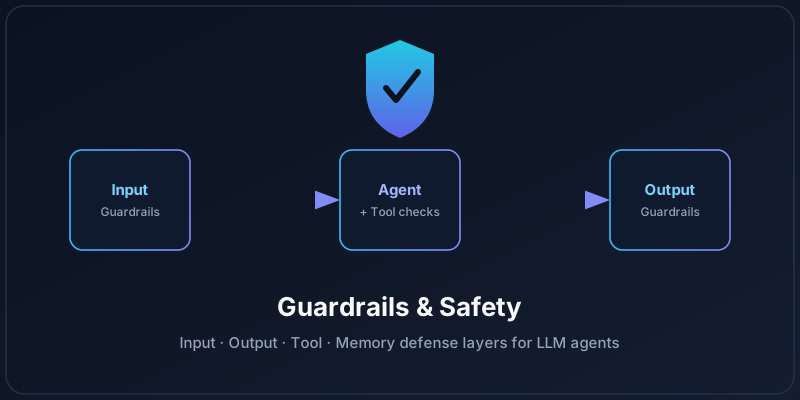
Guardrails, Security & Observability

Guardrails, AI/LLM security, evaluation, monitoring, and observability for safe, reliable production AI.

Guardrails & Safety for Production LLM Agents: Input, Output, Tool & Memory Defense Layers

Guardrails & Safety for Production LLM Agents: Input, Output, Tool & Memory Defense Layers

Engineering Implementation

A production engineering guide to LLM guardrails: layered input/output/tool/memory defenses, PII and prompt-injection detection, Guardrails AI validators, a policy-enforcer agent, and LangGraph guardrail nodes with human-in-the-loop.

  • Treats safety as a layered pipeline — input, tool, output, and memory guardrails each blocking a different failure class before it reaches the user
  • Deterministic detectors (PII, secrets, injection, SQL) handle the cheap cases; an LLM policy-enforcer handles the semantic ones pattern matching can't
  • Full Guardrails AI integration: validators, RAIL guards, OnFailAction (reask/fix/filter/refrain), and Pydantic-backed structured validation
  • Runnable LangGraph guardrail nodes — input screening, output redaction, human-approval interrupts, and bounded retry with routing
  • Grounded in NeMo Guardrails and Llama Guard, the two reference designs for programmable rails and LLM-based input/output safeguards
Guardrails AI Safety LLM Security Prompt Injection PII Detection Guardrails AI LangGraph Policy Enforcement Human-in-the-Loop
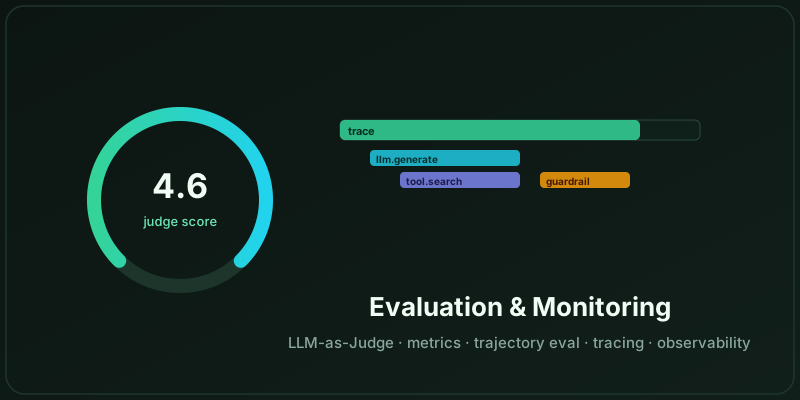
Evaluation & Monitoring for Production LLM Agents: LLM-as-Judge, Metrics, Trajectory Eval & Observability

Evaluation & Monitoring for Production LLM Agents: LLM-as-Judge, Metrics, Trajectory Eval & Observability

Engineering Implementation

A production engineering guide to evaluating and monitoring LLM agents: DeepEval metrics, LLM-as-Judge with bias mitigation, agent trajectory evaluation, contract-based checks, and a tracing stack with LangSmith, OpenTelemetry, and Arize Phoenix.

  • Separates offline evaluation (human, automated, CI/CD) from online evaluation (A/B, shadow deployment) — different questions, different tooling
  • DeepEval metrics for RAG and agents — answer relevancy, faithfulness, hallucination, custom GEval, and task-completion for full trajectories
  • LLM-as-Judge done properly: the failure modes (same-model, position, verbosity bias) and the concrete mitigations for each
  • Agent trajectory evaluation — scoring the sequence of tool calls, not just the final answer, with exact / in-order / any-order matching
  • A full observability stack: LangSmith tracing, OpenTelemetry spans, Arize Phoenix, structured logging, and the metrics-to-alert thresholds that matter
Evaluation Monitoring Observability LLM-as-Judge DeepEval Trajectory Evaluation LangSmith OpenTelemetry Tracing RAG Evaluation